By Deepti Yenireddy, CEO, Boon AI
A president of a $200M electrical contractor said something to me last month that I keep turning over.
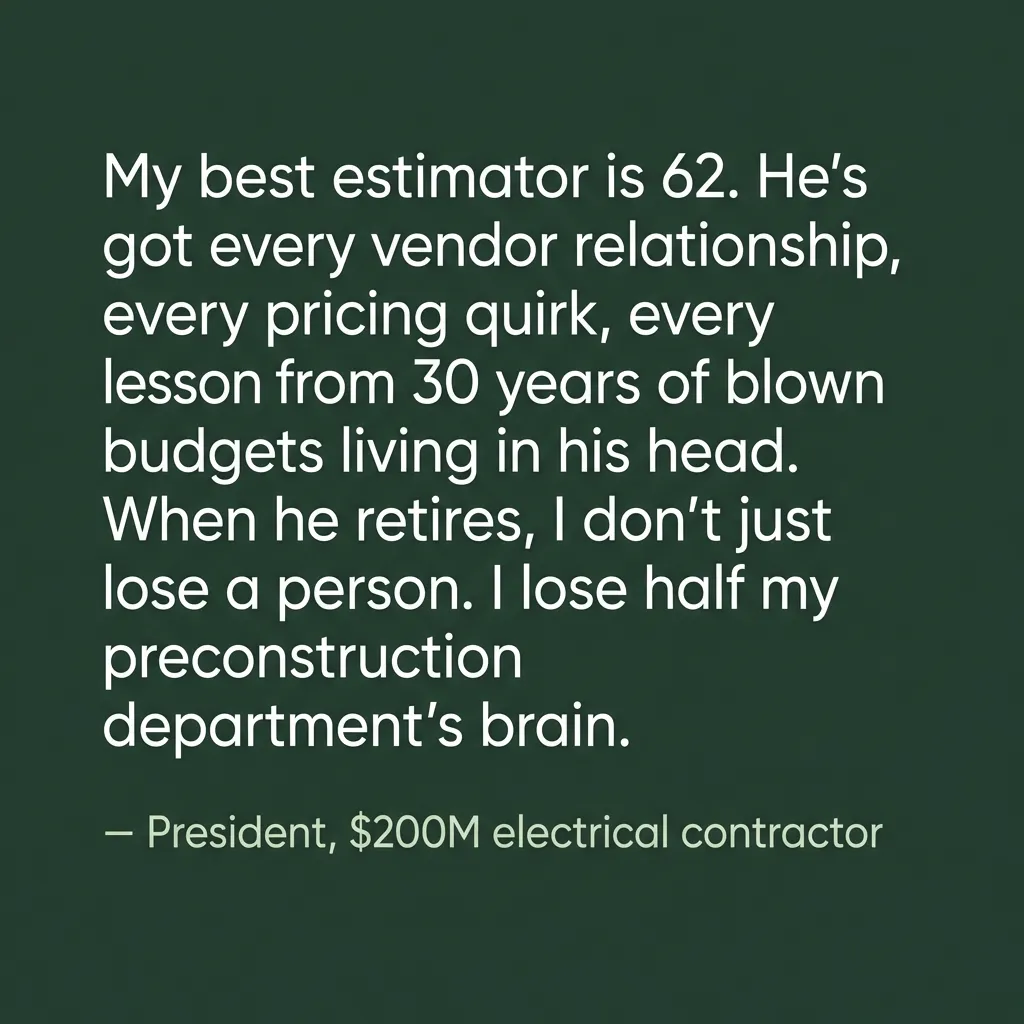
“My best estimator is 62. He’s got every vendor relationship, every pricing quirk, every lesson from 30 years of blown budgets living in his head. When he retires, I don’t just lose a person. I lose half my preconstruction department’s brain.”
He’s not alone. This conversation, with minor variations, has played out in nearly every meeting I’ve had with construction leadership this year. The feeling is consistent. So are the numbers. We’re staring down a generational cliff, and most firms aren’t ready.
The numbers
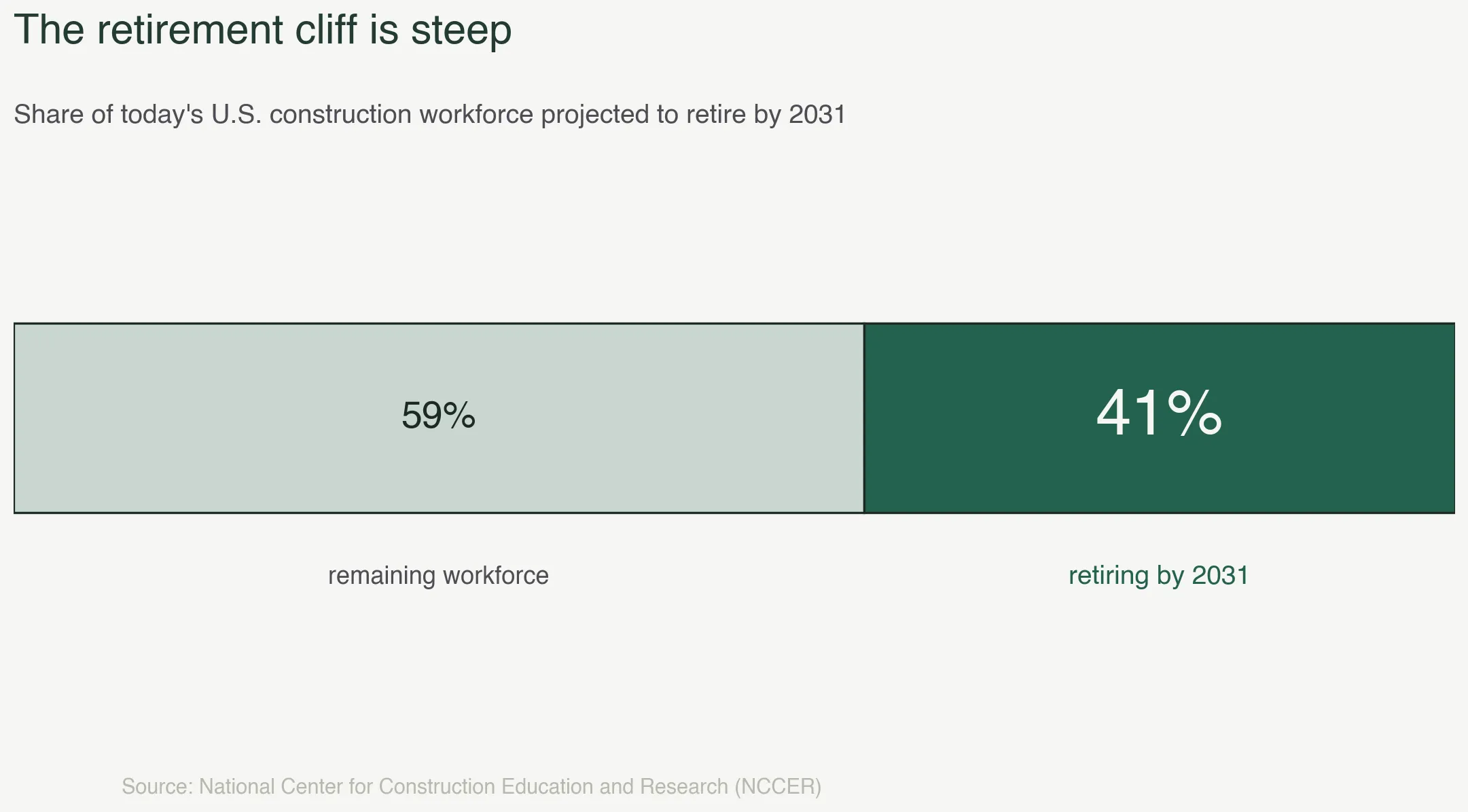
The National Center for Construction Education and Research (NCCER) projects that approximately 41% of the current construction workforce will retire by 2031, a mass exodus of skilled workers and institutional knowledge. That’s not a gradual transition. That’s a cliff.
And this isn’t just about field labor. The preconstruction side is getting hit harder than most people realize. Estimators, project managers, and superintendents have spent decades building mental databases. Regional pricing. Subcontractor reliability. Scope interpretation nuance. “Gut feel” calibrated by thousands of projects. They’re walking out the door with knowledge nobody wrote down.
Forbes called it “the construction industry’s silent crisis”, and silent is exactly the problem. A labor shortage shows up immediately. Empty hard hats on a jobsite. Knowledge loss is invisible until it’s too late. You don’t notice the gap until a bid comes back 15% over because nobody remembered the soil conditions at that site, or a change order blindsides you because nobody flagged the spec conflict your retired estimator would have caught on page three.
What walks out
Let’s be specific about what institutional knowledge means in preconstruction. It’s not just “experience.”
It’s the estimator who knows that certain spec language from a particular architect always means 20% more conduit than the drawings show. It’s the VP who remembers which GCs pay on time and which ones nickel-and-dime you on change orders. It’s the senior PM who can look at a set of drawings and tell you in five minutes where the clashes will be, because he’s seen that exact mistake four times before.
“We had a guy retire two years ago. Six months later we lost a $4M job because nobody knew his pricing methodology for underground electrical. It wasn’t in any spreadsheet. It was in his head.” (VP of Preconstruction, Southeast electrical contractor)
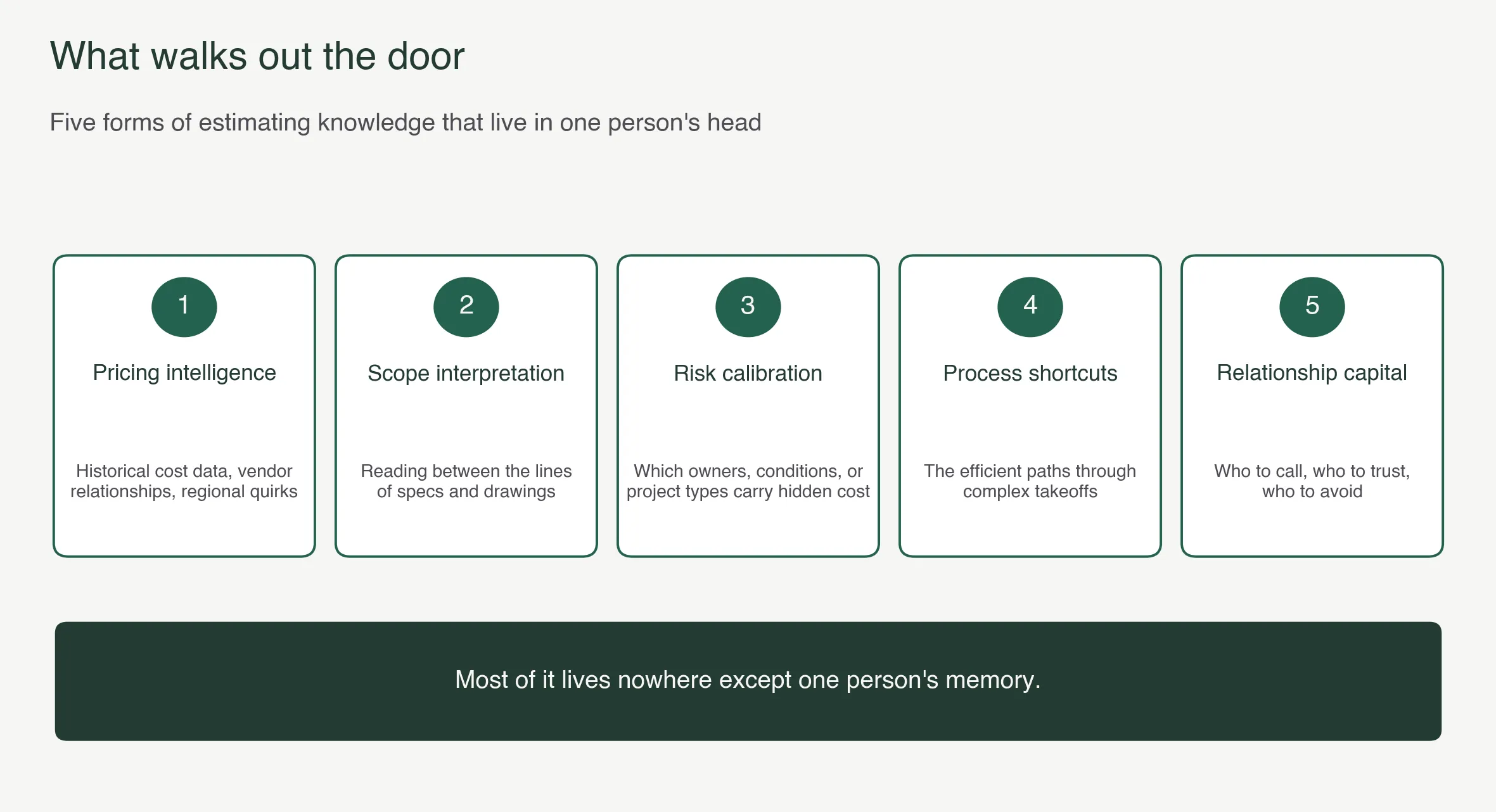
Most of this knowledge sorts into a few buckets:
- Pricing intelligence. Historical cost data, vendor relationships, regional pricing quirks.
- Scope interpretation. Reading between the lines of specs and drawings.
- Risk calibration. Knowing which project types, owners, or conditions carry hidden costs.
- Process shortcuts. The efficient paths through complex takeoffs that took years to develop.
- Relationship capital. Who to call, who to trust, who to avoid.
Most of it lives nowhere except one person’s memory. When that person leaves, the firm doesn’t just lose productivity. It loses competitive advantage.
Why transfer fails
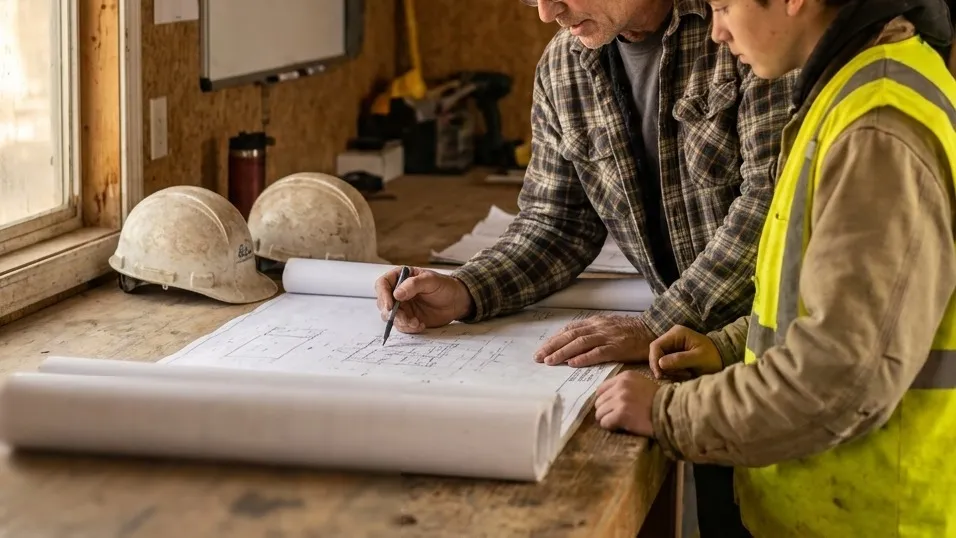
The standard playbook is mentorship. Pair the senior estimator with a junior, give them 12 to 18 months of overlap, hope the knowledge transfers through osmosis. The Associated Builders and Contractors has advocated structured knowledge transfer programs for years.
The problem? It doesn’t scale, and it doesn’t stick.
First, most firms can’t afford 18 months of overlap. The economics don’t work when you’re already running lean preconstruction teams. Second, tacit knowledge resists documentation. The kind that lives in someone’s gut. You can’t write a manual for “knowing when a number feels wrong.” Third, the junior estimator is trying to learn the basics and absorb 30 years of nuance at the same time. That’s like drinking from a fire hose while reading a textbook.
“I’ve tried the mentorship thing three times. Each time, the young person gets maybe 30% of what the senior knows. The other 70% just evaporates.” (Owner, Midwest mechanical contractor)
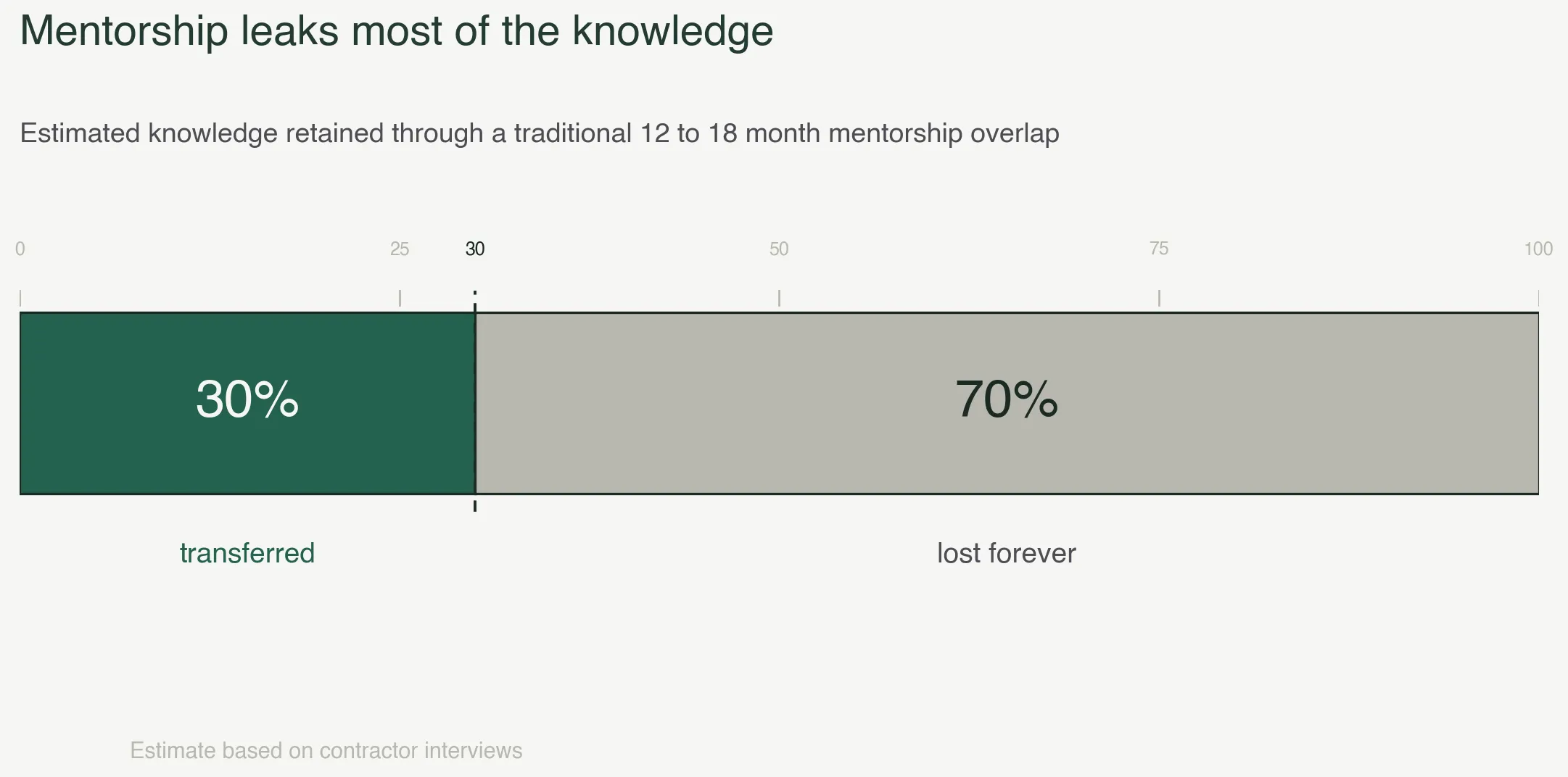
There’s a reframe hiding in that 70%. The goal shouldn’t be transferring knowledge from one person to another. It should be codifying knowledge into systems that everyone can reach.
Think about what happens when a senior estimator does a takeoff. They’re making hundreds of micro-decisions. What to count. What to skip. How to read an ambiguous detail. Where to add contingency. Those patterns are valuable. They’re also capturable.
AI takeoff tools today can observe and learn estimation patterns. Not to replace the estimator. That’s a misunderstanding that keeps coming up. The point is to preserve their method. When your best person does a takeoff, the system learns their approach. When a junior estimator works the same scope six months later, the system can flag the gap: “Your predecessor typically added a 15% waste factor for this type of conduit run. You’ve got 8%.”
This isn’t science fiction. It’s already happening. APQC’s 2025 research found that AI is beginning to play a real role in capturing and preserving institutional knowledge, particularly in industries where expertise is concentrated in a small number of people. Construction fits that description well.
What now
If you’re a president or VP reading this, here’s the honest assessment. You probably have 3 to 5 years before the retirement wave hits your preconstruction team hardest. That’s not a lot of runway.
A few practical steps.
Audit your knowledge concentration. Identify the 3 to 5 people whose departure would cause the most damage. Be honest about how much of their value is documented versus living in their heads.
Start capturing patterns now. Don’t wait until someone gives their two weeks. Every takeoff your senior people do is a chance to learn, but only if you have systems recording those decisions.
Invest in tools that learn. The next generation of preconstruction software doesn’t just automate tasks. It watches how your best people work and preserves that method for the team. Whether it’s electrical takeoff software or HVAC takeoff tools, this is where AI in preconstruction has its most underappreciated value.
Create overlap deliberately. Even if you can’t afford 18 months of mentorship, you can build structured handoff protocols. Pair the people with technology that captures what the mentorship misses.
As one contractor told us: “We know it is a changing world and we got to stay on top of the latest and greatest.”
Here’s the part I keep coming back to. Your 30-year estimator is your competitive edge. Their accumulated judgment is what lets you bid accurately, win work profitably, and avoid the jobs that would hurt you. When they’re gone, what remains?
The firms that preserve institutional knowledge, not in binders nobody reads but in living systems that shape daily work, will pull ahead over the next decade. The firms that don’t will spend years relearning lessons someone already knew. The silver tsunami is coming. The question isn’t whether it’ll reach your organization. It’s whether you’ll have preserved what matters before the wave arrives.
Sources
- Construction Workforce Crisis (CIC Construction)
- The Construction Industry’s Silent Crisis (Forbes)
- Turning Brain Drain into Knowledge Transfer (ABC)
- The Great Retirement and Knowledge Loss (APQC)
Deepti Yenireddy is the CEO and Founder of Boon AI, a platform helping construction firms automate preconstruction workflows and preserve estimating intelligence.