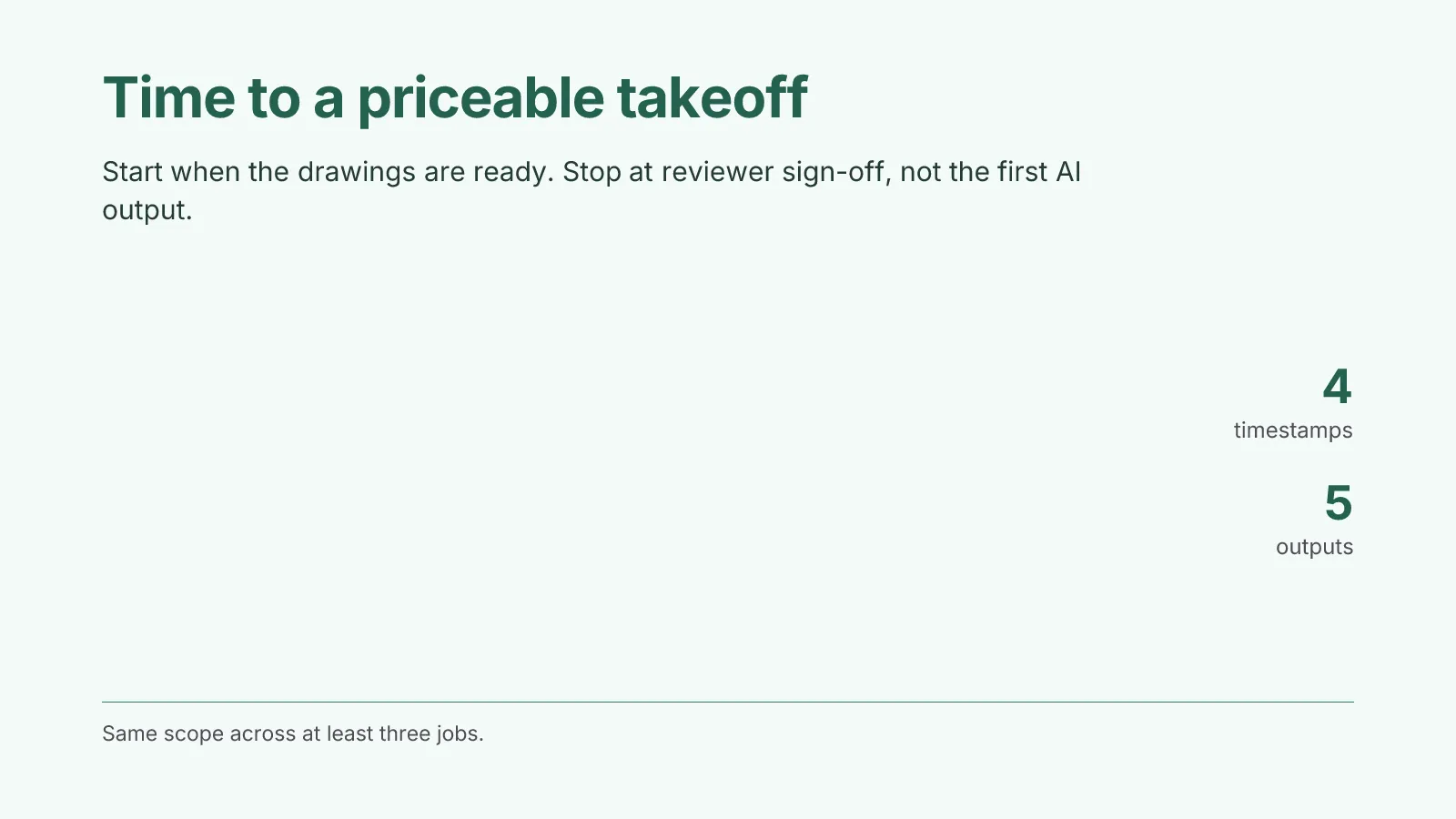
In AI construction estimating, speed means time from drawings-in to a reviewed, priceable takeoff. The first AI file is only a checkpoint.
Our F1 post and Trust Chasm establish the vendor-selection gate. This scorecard starts after that point. Run the same scope across at least three jobs and record four timestamps and five outcomes to see where the time and reviewer effort go.
Measure the full workflow
The 78% accuracy post explains why quantity differences do not tell you how the workflow went. Measure elapsed time from drawings-in to a reviewed takeoff your team can price. The first reviewable output is a checkpoint, not the finish. Track time to sign-off and reviewer minutes separately; one measures turnaround, the other hands-on labor.
Hold the job constant
Use the same priced job or representative sheet set for every system. Keep the drawing revision, trade scope, units, inclusions, exclusions, and estimate assumptions consistent. If those change, write down what changed. Otherwise, you can’t tell whether the result came from the system or the job.
Choose work your team recognizes, not only the easiest sample in the folder. A clean, simple set can hide the review work that matters on a real bid. Start with a representative set, then run the same protocol on at least three jobs before you generalize.
Record four timestamps

Use the same clock for every run. Record when:
- The drawings are available.
- The AI run starts.
- The first reviewable output is available.
- The reviewer signs off or records the remaining exceptions.
Define each event before testing. For example, decide what your team means by “reviewable” and what is required before a takeoff is priceable. A vendor’s first file may arrive before those conditions are met. Don’t let the timer stop just because a screen says “complete.”
These timestamps show where time goes. The gap from run start to first reviewable output measures when the review can begin. The path from drawings available to sign-off measures the full elapsed workflow. Those are elapsed times, not labor minutes. If the job waited in a queue or a reviewer was pulled away, note it. You can’t call the wait active work.
Report five outcomes
For each job and system, record five outputs:
- Elapsed time to first reviewable output.
- Elapsed time to a reviewed, priceable takeoff.
- The number of exception classes observed, not only the total exception count.
- Reviewer minutes spent correcting or adding scope.
- The final decision: use, revise, or reject.
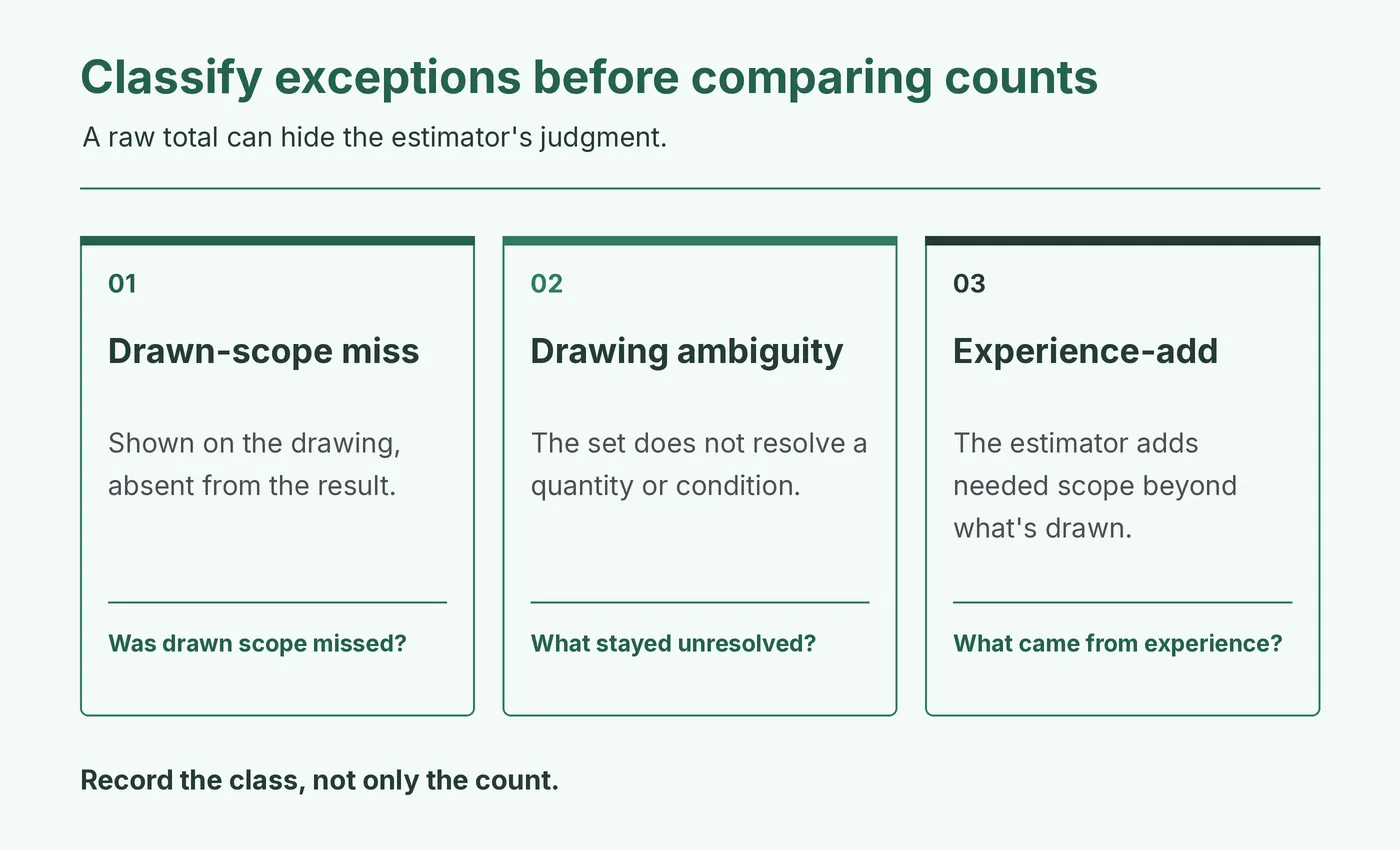
Exception classes matter because two lists of ten issues can describe very different work. Separate missed drawn scope from drawing ambiguity and from experience-adds that are outside the drawn set. Add other classes when the work demands them. The point is not to create a universal taxonomy. It is to show what kind of judgment the reviewer supplied.
Keep the first two times distinct. If the first output arrives quickly but the reviewer spends the rest of the afternoon correcting it, the first number is not the result your team buys. The second one is closer to the workflow endpoint. Reviewer minutes explain how the team got there.
The review-pass walkthrough shows why that middle part deserves its own line. Review is not one undifferentiated block. It has recognizable checks, and the minutes tell you which of them are carrying the work.
Keep accuracy separate
Set your accuracy bar before the run and record pass/fail on a separate line. A tool that misses it is not a speed win. This keeps vendor selection separate from the adoption question here: for systems that pass, how long to a reviewed, priceable takeoff?
Turn time into capacity carefully
A shorter reviewed workflow can create capacity. It does not automatically create more bids. The firm still needs enough qualified pursuits, and someone still has to price, review, submit, and deliver them.
Separate the estimator hours you actually recover from the business decision about where to use them. A team might take on more pursuits, spend more time reviewing scope, shorten turnaround, or reduce overtime. Those aren’t the same choice. The scorecard can inform them, but it can’t make the choice for you.
The trade ratios in our trade companion are context, not a promise about your workload. Measure your own bids. Keep elapsed turnaround separate from hands-on reviewer minutes, and use comparable work when you calculate a ratio. If the estimating task gets faster but business-development capacity is already full, pursuit volume may not move. That’s a constraint to name, not a reason to inflate the score.
Make the decision traceable
At the end of each test, keep the job identifier, drawing revision, scope, accuracy result, four timestamps, five outputs, and the decision together. Note what changed between runs. Don’t average away a safety failure, and don’t generalize from one convenient job.
A scorecard won’t tell you that a system is safe on every drawing. Three jobs won’t represent every trade, document quality, or project condition. It gives you a fairer comparison and a record of what your estimator had to do after the AI finished.
In the next evaluation, ask every vendor to time the same scope from drawings-in to reviewer sign-off. Record the first reviewable output and reviewer minutes too, but keep them separate from end-to-end workflow time. Compare like with like. That is the speed measure your team can use. If you’d like to walk through the scorecard on your own workflow, talk with our team.