Bid day is underway. The estimator opens the Excel estimate template. Quantities are ready, but each row still needs a source reference before pricing.
In Boon Agent chat, the estimator asks Boon to prepare the Excel estimate template from the plan set. Boon provides the estimate data for Excel or CSV export.
The estimator checks that each exported row has the correct drawing or specification reference, then approves the workbook for pricing.
A row needs a way back
Estimate workbooks are built to calculate. A row can hold a cost code, quantity, unit, and amount. That structure is useful, but it doesn’t guarantee the row carries its own explanation.
A note that says “per plans” isn’t enough when the plan set has multiple sheets, details, and revisions. A filename isn’t enough if a reviewer can’t find the relevant location inside it. A copied specification excerpt isn’t enough if the scope depends on a drawing detail nearby.
What the recipient needs is a short path from the estimate line back to the evidence. The link can be a sheet and detail, or a specification section and paragraph. The note should tell the reviewer why that passage matters to this line, not just where it exists.
This is a handoff problem, not a formatting preference. A number can be carried into a workbook in seconds, while its context takes longer to recover later. That imbalance is where assumptions quietly become facts.
Five checks before it travels
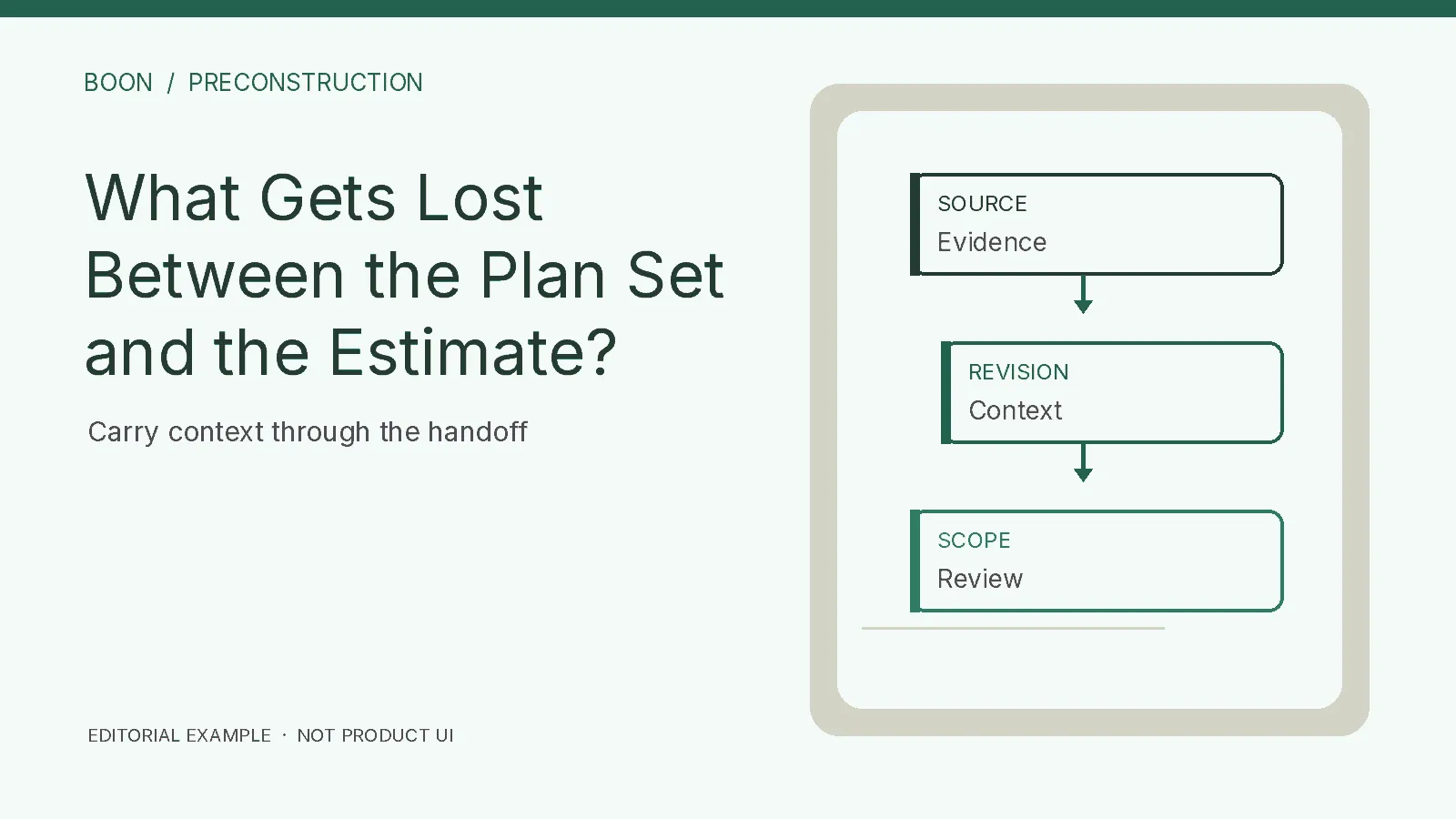
Before a number moves from the plan set into the estimate, the estimator can ask five questions:
- Source: Can the reviewer open the sheet, detail, or specification passage behind the line?
- Revision: Does the reference come from the issue the team is pricing?
- Scope: Is it clear which package or work boundary the line covers?
- Assumption: Is any missing information labeled as an assumption instead of a fact?
- Status: Can the next person tell whether the line is still under review or accepted for the bid?
If a source reference points to an unresolved detail, that row can carry the open question beside the quantity before the file travels further.
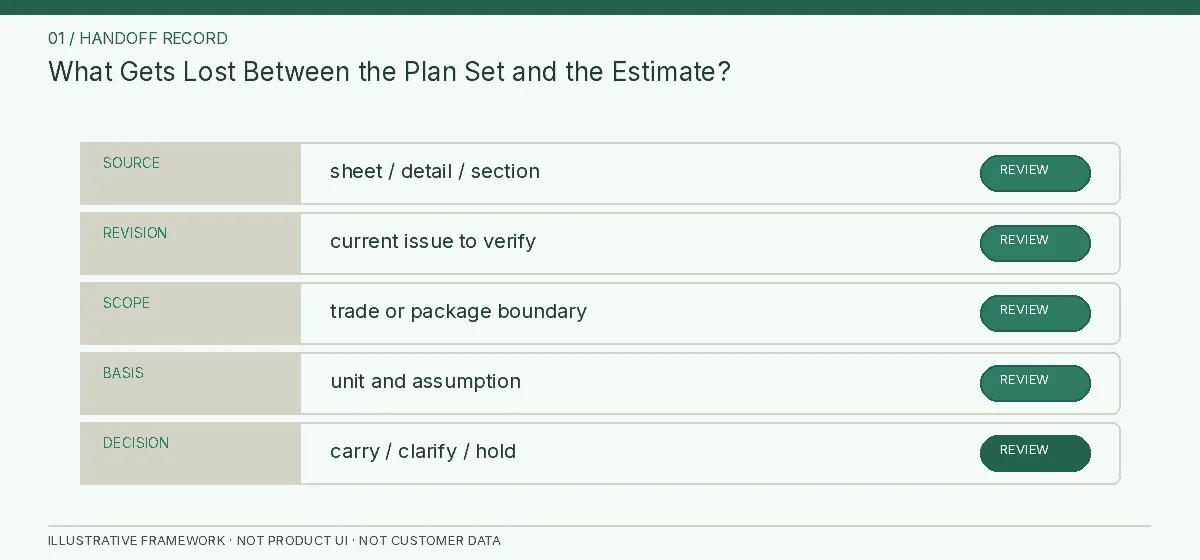
Keep the explanation close
The estimate should still make sense after it leaves the first estimator’s screen. A reviewer needs a clear path from the line to the drawing or specification that supports it, with any assumption labeled separately.
Boon is the AI built for preconstruction: it also reviews specs by trade, levels subcontractor quotes, and drafts cited RFIs.
If the source does not support the quantity, the open question should be visible before the bid relies on it. The number should travel with its basis, not with an explanation that only one person remembers.
Related: Boon Agent · Preconstruction series hub A VE Deduct Is Only Useful If You Can Trace It · Book a demo