SEO targets: agentic ai in construction | ai agents for construction, ai construction tools
An estimator I talked to last month had three bids due Friday and one person out sick. He wasn’t looking for a smarter search box. He needed the actual work done: the full bid set read, the scope gaps found, the RFIs written before the questions were due to the GC. That gap, between a tool that answers a question and one that does the job, is what agentic AI in construction actually means. It’s the difference between something that helps you think and something that hands you a first draft of the work.
The phrase gets used loosely right now. Every product with a text box is calling itself an agent. So it’s worth being precise about what the word should mean before the category gets diluted into nothing.
What agentic AI in construction actually means
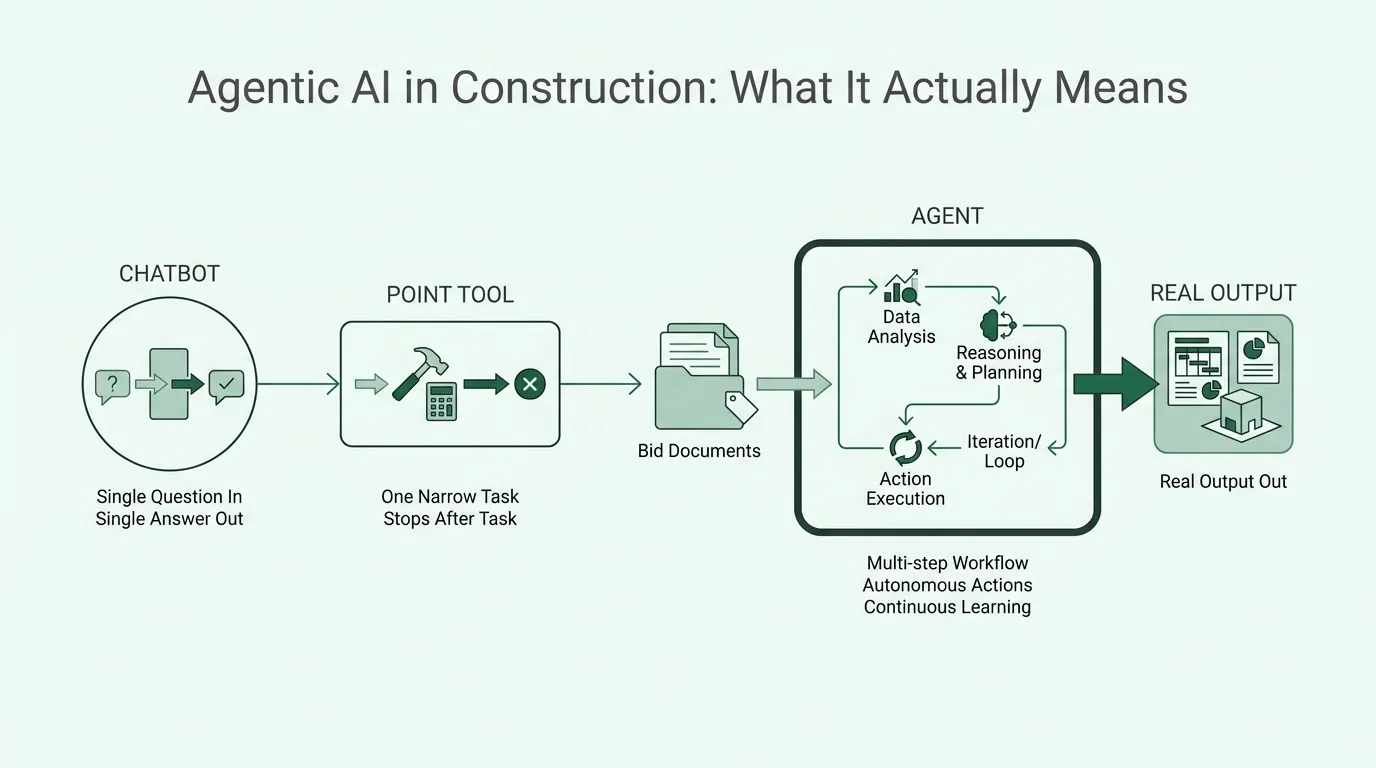
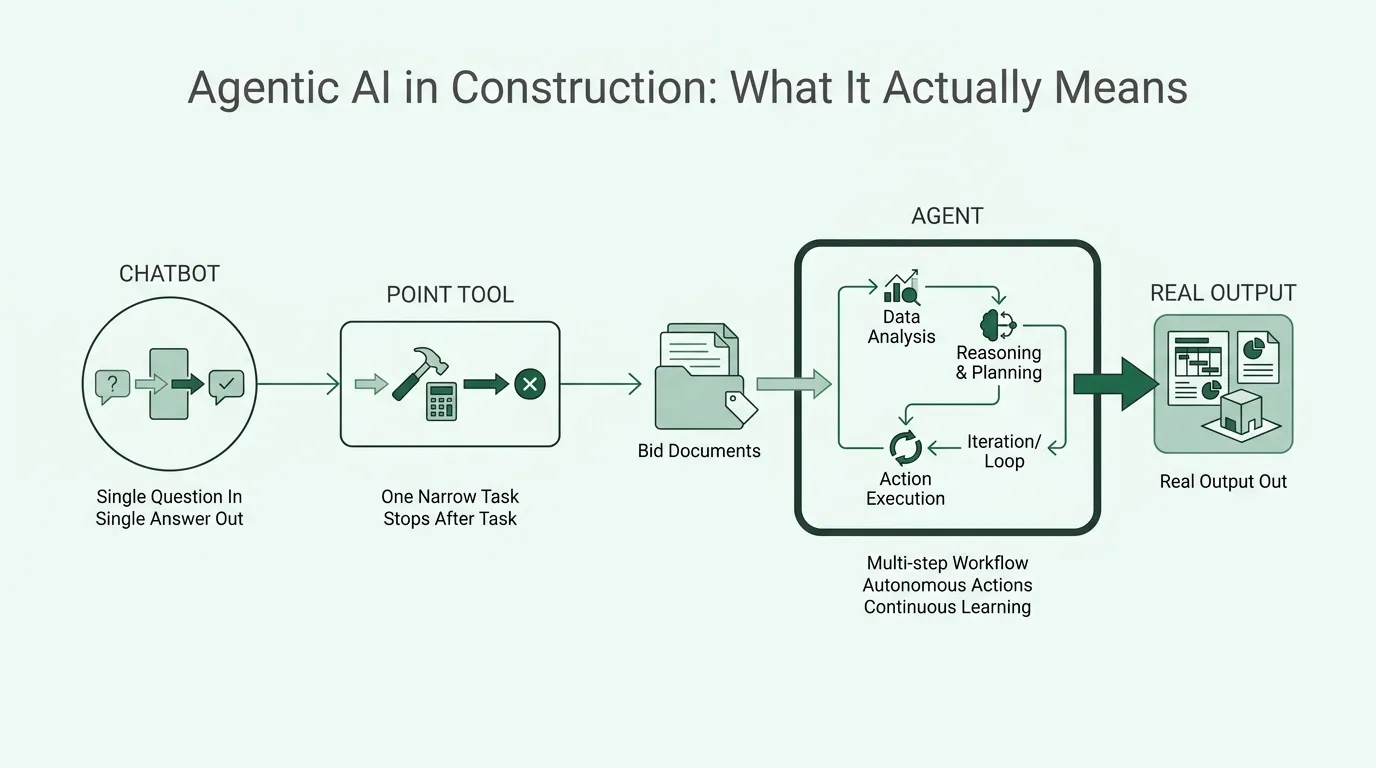
A chatbot waits for you to ask. You type a question, it returns an answer, and the next step is yours. A point tool does one narrow thing well: it counts fixtures, or it flags a clash, and then it stops. Both are useful. Neither is an agent.
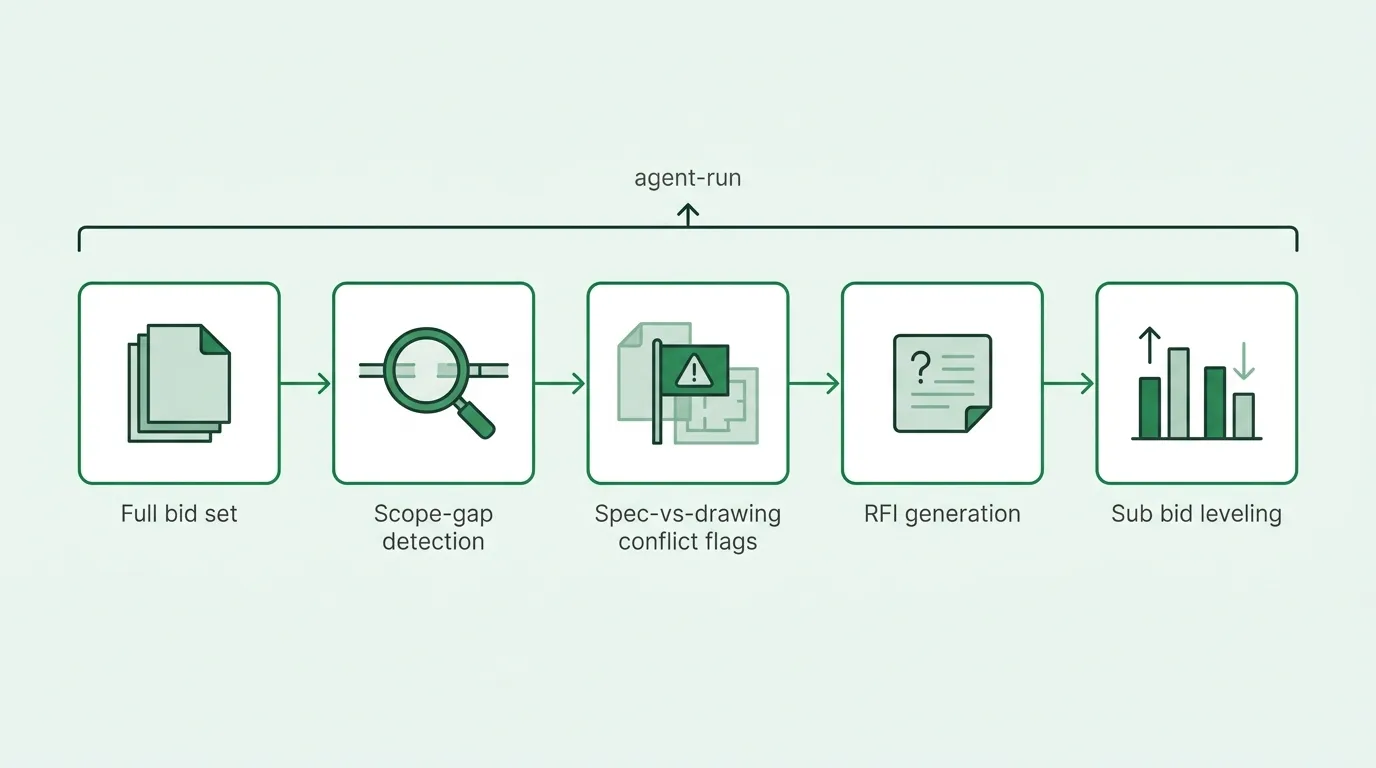
An agent runs a multi-step workflow on its own. You give it a folder of bid documents and a goal, and it plans the sequence, executes each step, and produces the output the step was for, without you driving every keystroke. In preconstruction that sequence is concrete. Read the full bid set. Find the scope gaps between the drawings and the specs. Draft the RFIs those gaps imply. Level the sub bids that come back. Each step feeds the next, and the agent carries the context forward instead of making you re-explain the project every time.
The distinction matters because construction work is sequential and it compounds. A question-and-answer tool leaves the sequencing to the human. An agent owns the sequence. That’s the line.
The estimator’s day is a workflow, not a query
Spend a morning next to a preconstruction lead and you stop thinking about AI as a question-answering machine. Their day isn’t a series of questions. It’s a series of handoffs, each one waiting on the last.
The plans arrive. Somebody reads all of them, cover to cover, because the fixture schedule on one sheet governs the count on another and the addendum three pages in quietly changes the wall type. Then somebody cross-checks the drawings against the specifications, because the drawing says one thing and the spec section says another and the gap between them is where the change orders are born. Then somebody writes the RFIs, phrasing each one carefully because a sloppy question gets a useless answer and burns a day of turnaround. Then the sub quotes come in, and somebody lines them up side by side to see who actually covered the full scope and who quietly left out the fireproofing.
None of those steps is a query. Each one is a job, with an input, a judgment, and an output that the next step depends on. A tool that answers questions can help inside a step. It can’t carry the estimator across the steps. That’s the work that eats the week, and it’s the work an agent is built to run.
What a real construction agent does
Here’s the useful test for whether something is an agent or a wrapper around one: hand it the raw bid set and see if it produces the work, not just commentary about the work.
Boon Agent is built to run that preconstruction sequence directly. Point it at a folder of bid documents and it reads the full set. It surfaces the scope gaps, the places where the drawings and the specifications disagree, so the estimator sees the conflict before it becomes an assumption baked into the number. It generates the RFIs those conflicts call for, drafted and ready to review rather than described in the abstract. And when the sub quotes come back, it levels them, putting the bids on a common basis so the estimator can compare apples to apples instead of reconciling five different formats by hand.
That’s a workflow with real output at the end of it: a reviewed set of RFIs, a leveled bid comparison, a flagged list of spec-versus-drawing conflicts. Not a summary. Not a suggestion to go check something. The actual artifacts the estimator would otherwise have produced by hand.
The other half of “real” is where it runs. An agent that lives in a separate dashboard is an agent the estimator stops opening by week three, because their work already lives somewhere else. Boon Agent runs inside Slack and Teams, the tools the team is already in all day. The work comes to the workflow instead of asking the workflow to come to a new tab.
Why the difference is more than semantics
It would be easy to treat all this as a naming argument. It isn’t. The gap between a chatbot and an agent is the gap between a tool the estimator has to operate and a teammate that does a piece of the job.
A question-and-answer tool adds a step to the estimator’s day. They still have to know what to ask, ask it, read the answer, decide whether to trust it, and then do the actual work themselves. On a tight bid week that isn’t help, it’s overhead. An agent removes steps. It does the reading, the cross-checking, the drafting, and hands back something the estimator reviews and corrects rather than builds from scratch. Reviewing a draft is faster than authoring one. That’s where the time comes back.
There’s a trust dimension too. A tool that answers a question in isolation gives you no way to see its reasoning across a workflow. An agent that runs the whole sequence can show its work at each step: here’s the conflict I found, here’s the RFI I wrote for it, here’s how the sub quotes line up. The estimator stays in control, checking the output, keeping the judgment calls. The agent carries the load in between.
Where this is going
The word “agent” is going to get stretched over a lot of products this year, most of which are chatbots with a new label. The way to cut through it is to ask what the thing produces. If the answer is “answers,” it’s a chatbot. If the answer is “one narrow output,” it’s a point tool. If the answer is “the multi-step work an estimator would otherwise do by hand, delivered where they already work,” that’s an agent.
Construction is a good place to draw that line clearly, because the work is so obviously a sequence and the cost of a broken handoff is so concrete. An estimator doesn’t need a smarter search box. They need the bid set read, the gaps found, the RFIs drafted, the quotes leveled, before Friday. That’s the job. An agent is the thing that does it.
If you want to see what that looks like on your own drawings, try Boon Agent on a real bid set and watch it run the workflow, not just answer a question.
Deepti Yenireddy is the founder and CEO of Boon AI.