The scope narrative due Wednesday isn’t hard. It’s long. One electrical contractor running sheets through our agent reports about an hour saved per sheet and 16 to 24 hours back on a 16-sheet job. A customer typed his own loaded rate into the agent this week (“$50 per hour plus 30% burden”), so call it $65/hr loaded: roughly $1,000 to $1,600 of your time per job, on one deliverable, before you’ve opened a contract.
Here’s what PMs actually hand off, ranked by how often they ask.
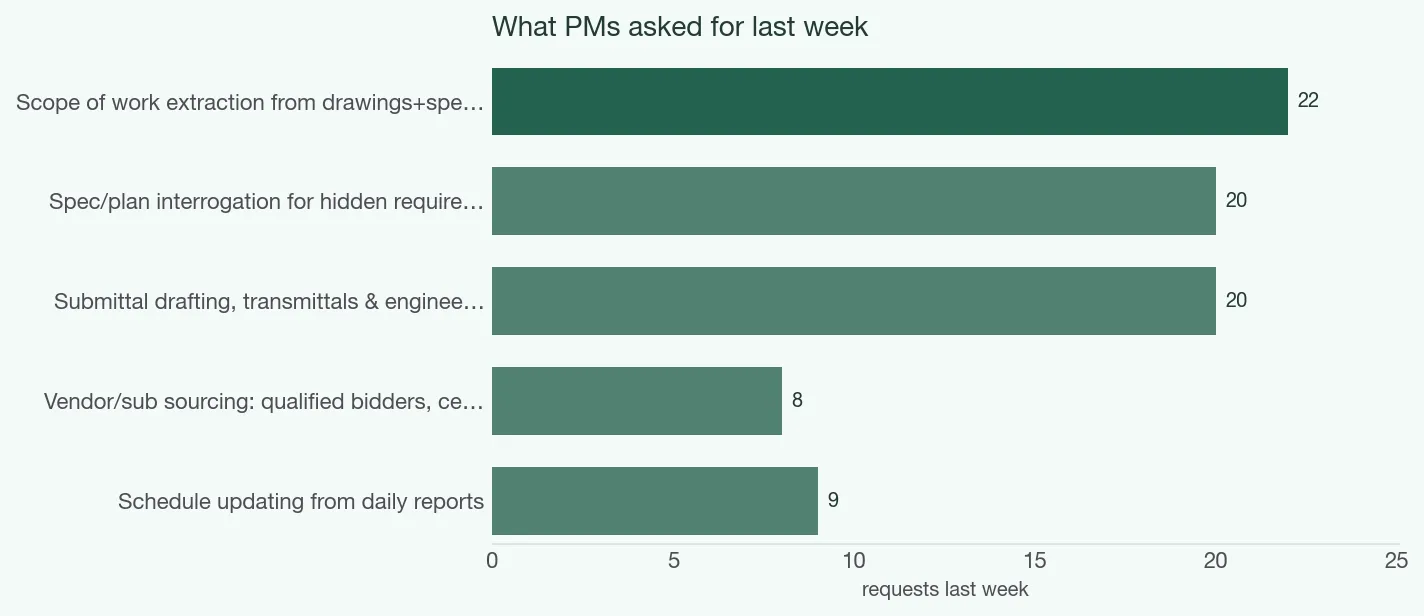
Plan set into a scope of work
Twenty-two requests last week, seven contractors, all the same shape: turn these drawings and specs into a scope somebody can act on.
“Can you combine these two documents into one DFOW for underground.”
“What is the concrete scope for the [project]?”
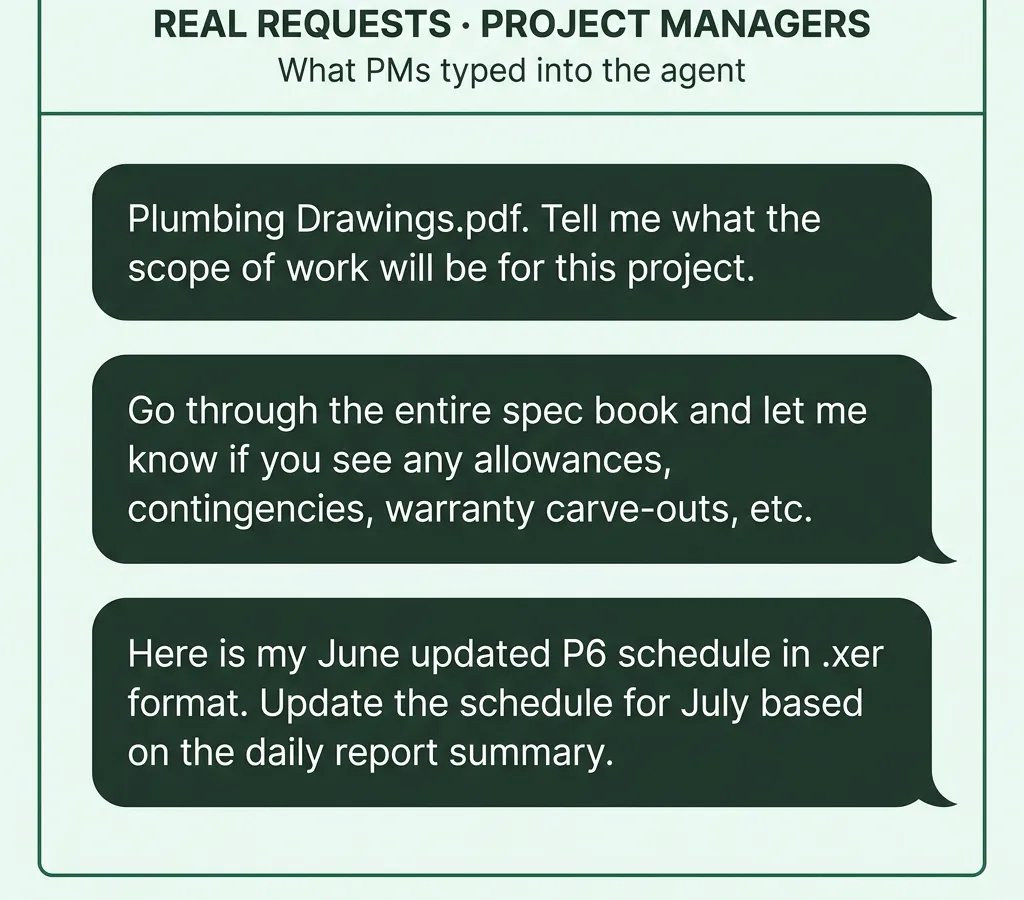
“Plumbing Drawings.pdf. Tell me what the scope of work will be for this project.”
This is the most-asked PM task by a wide margin, and it’s the one that reads like grunt work but decides your whole job. A trade scope narrative pulled from the plans and specs is the document your foreman, your subs, and your own estimate all lean on. Written by hand it’s half a day of reading and typing. At the rate above, those 22 requests are roughly 22 x 1 hour x $65/hr = about $1,400 of PM time across seven firms, and that’s the conservative version, since most of these took far longer than an hour by hand.
The nine things buried in the spec book that kill your margin
Twenty requests, four contractors. This is the one PMs underrate.
“Go through the entire spec book and let me know if you see any allowances, contingencies, deferred design delegation, warranty carve outs, etc.”
“Review the plans and specs for [project] and tell me what submittals are required for the shade structures.”
“Can you add how many inches of bedding is required under the manholes.”
That first request is a person who has been burned. Allowances, contingencies, warranty carve-outs, submittal requirements, bedding depths: none of them are on the drawings, all of them are in a 300-page spec book, and every one you miss is a change order or a margin hit later. Reading a spec book cover to cover for the buried requirements is an afternoon nobody has, so it doesn’t happen, and the item surfaces three months into the job. Ask once, get the list with the section cited, and that whole category of miss goes away.
Submittals drafted from the cut sheet, not from scratch
Twenty requests, and here’s an early signal worth watching: they came from one contractor, which is what heavy adoption looks like before it spreads.
“Run the submittal skill for [project] fields.”
“Draft a submittal for AWP on [project].”
“Summarize the aggregate submittals and tell me what is needed to address the engineer’s comments.”
A submittal package drafted from the vendor cut sheet and the relevant spec section is production work, 1 to 2 hours each, and it’s the work that piles up when a job hits its stride. The engineer-comment resolution is the quiet win: instead of re-reading every comment cold, you get a summary of what’s outstanding and what closes it out.
The sole-source spec, and five compliant alternates
Eight requests, three contractors.
“Take this Architrac specifications sheet and provide 5 comparable curtain tracks that match the specifications, provide pricing as well as contact information for representatives.”
“Can you review the permeable pavers spec on the [project] and find contractors in San Antonio who have the certifications required?”
“Are there approved fire alarm bidders?”
A spec’d sole-source product with a 12-week lead time is a schedule risk you find out about too late. Sourcing compliant alternates with reps and lead times is a couple hours of calling and searching. Get five back with contacts, and you’ve turned a bottleneck into a decision you make on your own timeline.
Daily reports in, .xer update out
Nine requests, one contractor, so treat this as an early signal too.
“Review these daily reports for the month of July and let me know what work was conducted by what subcontractor in an executive summary, I need to update the schedule.”
“Here is my June updated P6 schedule in .xer format. Are you able to update the schedule for July based on the daily report summary you gave me?”
“Can you confirm that updating these dates did not push out my substantial completion date?”
The monthly P6 update is retyping, taking what the daily reports already say and moving it into the schedule. That last question is the one that matters: not “update the dates” but “did the update push my substantial completion.” One specialty contractor’s full precon pass, triage through bid package through spec review, runs in about 7 minutes against 112 to 154 hours manually. The schedule round-trip is the same idea pointed at the field.
What it adds up to
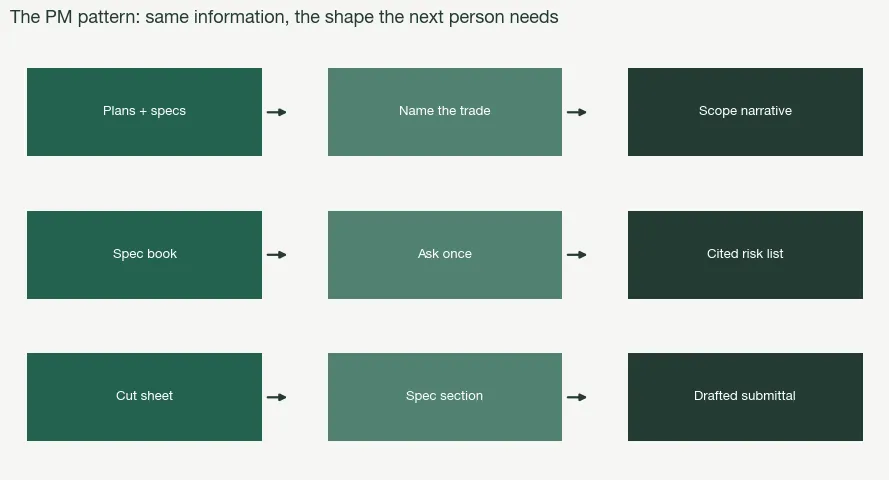
Five categories, one job: moving information you already have into the shape the next person needs. Plans to scope. Spec book to risk list. Cut sheet to submittal. Hand off a few in a week and at $65/hr loaded you’ve bought back most of a working day, plus the 16 to 24 hours on the next 16-sheet job. That’s not a smaller team. It’s the fourth bid you weren’t going to get to.
Send us your worst spec book and see what comes back.