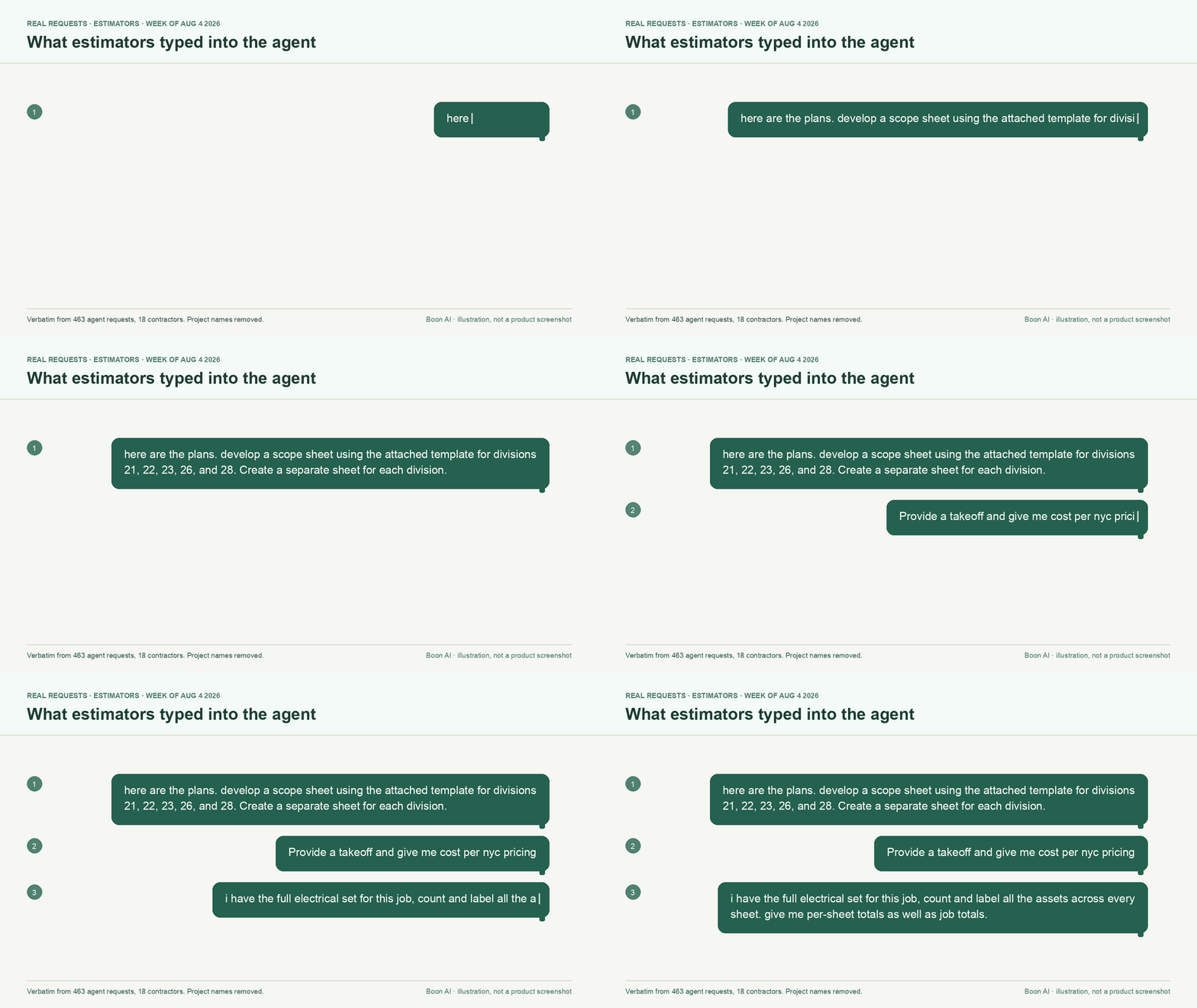
Four shops sent us the same request twenty-two times in seven days: take the spec book and the drawings, and give me an Excel scope list for the trade I care about. Electrical scope for the electrical sub. Plumbing scope for the mechanical sub. Sitework scope for the utilities contractor. Not a summary. Not a narrative. The actual scope sheet you would email a sub tomorrow, in the columns your firm already uses. This was the top-ranked ask across every estimator we track this week, above counts, above budgets, above formatting.
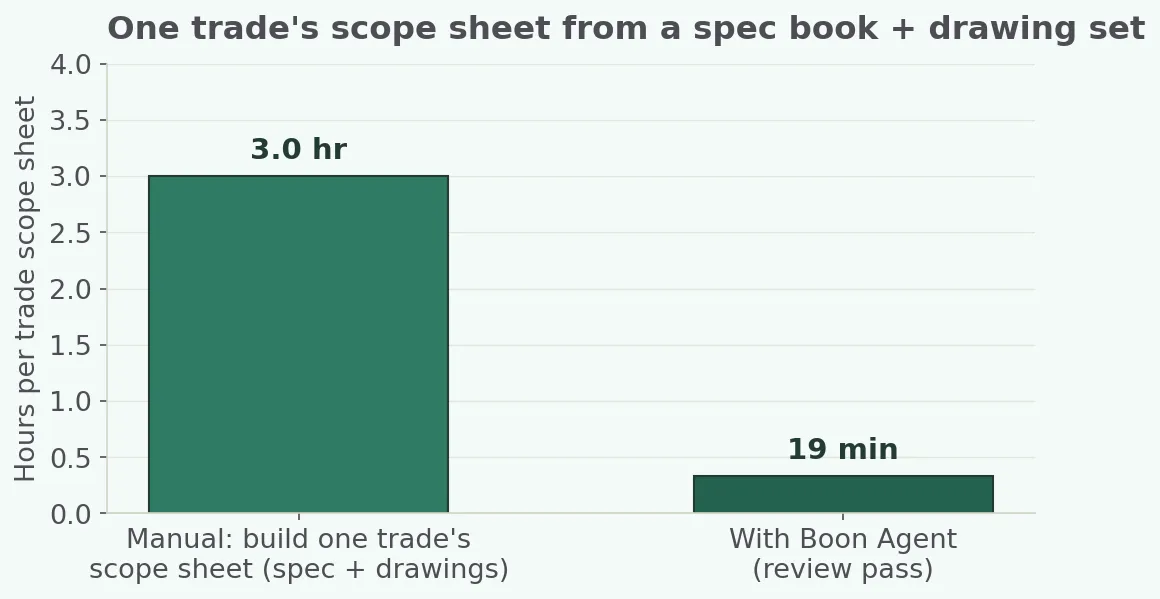
The math is small numbers times a lot of trades. A scope sheet for one CSI division, built by hand off a spec book and a drawing set, runs roughly 3 hours, one hour to hunt through the spec sections that touch that trade, one to walk the drawing set for the callouts, one to line it up in the workbook you send out to bid. At a fully loaded rate of $65/hr (a real customer’s math from a chat this month: $50/hr plus 30% burden), that’s about $195 per trade scope. A typical bid touches five to eight trades. That is roughly $1,000 to $1,600 of scope-sheet time per project, before a single quote comes back. And every trade you skip goes out with a hole, and every hole comes back as a change order.
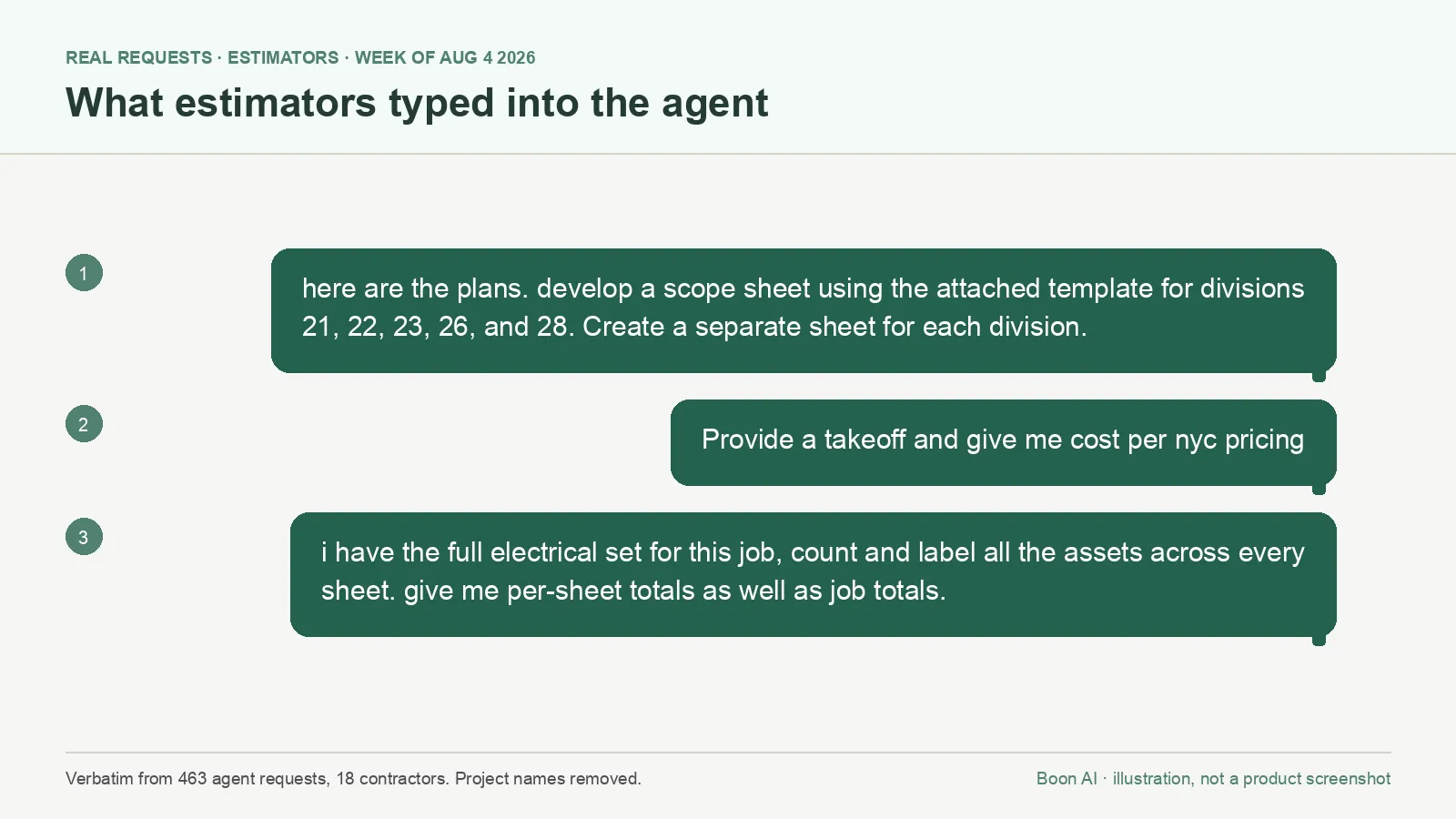
Here is what estimators actually handed the agent this week, in their own words.
The scope list by trade. In Excel. Ready to email out to bid.
The biggest single ask this week, in their words:
“Give me an excel scope list for Electrical subcontractor”
“for Roselawn Elementary Give me an excel scope list for Electrical subcontractor, Plumbing & Mechanical Contractor and Utilities Contractor”
“Using the specsifications can you create me a DFOW for Overhead Lighting all essential specifications as well as conduit coloring and labeling of Junction boxes”
You point the agent at a spec book and a drawing set, name the trade, and get back an Excel scope list, the section references, the callouts pulled from the drawings, and the spec paragraphs the sub is responsible for reading before they price it. Twenty-two asks like this in a single week, from four separate shops. Three hours of hunting for one trade drops to a twenty-minute review pass on a filled workbook.
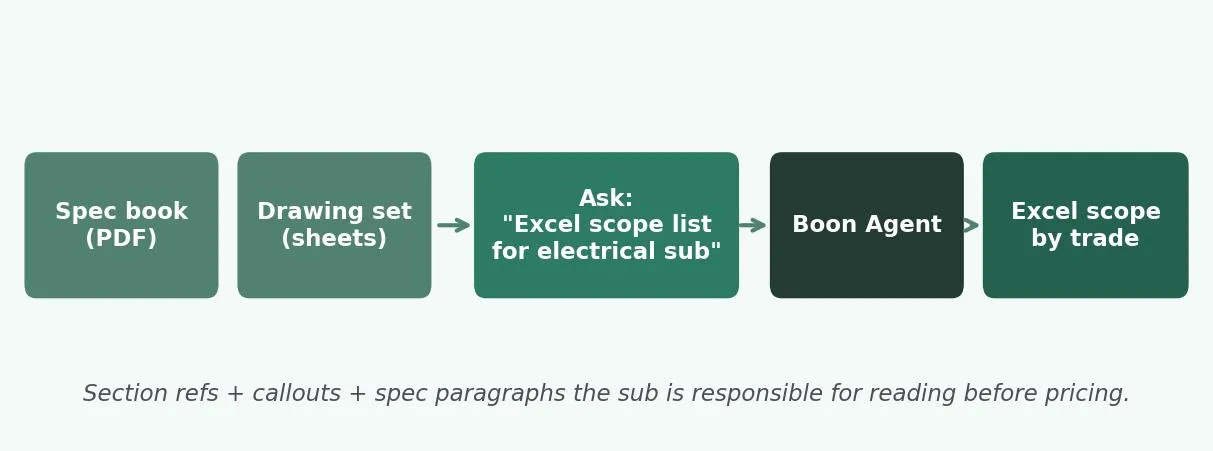
On the Roselawn Elementary ask above, the estimator wanted three trades in one go. That is nine hours of scope work turned into an hour of review, or roughly $520 of estimator time back per project. The correction loop is where trust builds: the reviewer points at a line and says “this belongs to the sitework sub, not the plumbing sub,” the agent re-cuts it, everything else stays. That is the shape of a scope tool that survives past the first bid.
Count what’s on the drawings. In minutes. Not in overtime.
Second-biggest ask, and the one that funds the scope work, real quantity takeoff off the plans:
“Can you provide a weld count and a material take off of this drawing”
“Do me a door take off on a project”
“Please give me an accurate count of the culverts and headwalls in the plans”
Drop in a plan sheet, name what you count (welds on structural steel, doors on a school plan, culverts and headwalls on a civil job), get counts back with the drawings marked up. An electrical sub we work with cut about one hour per sheet off their manual takeoff pass with this loop, and told us it scales to 16 to 24 hours saved on a 16-sheet job. A structural sub cut beam takeoffs 25 to 30% and turned a three-day manual takeoff into a one-day pass, two full days per bid back on the calendar. An electrical lighting sub went from two hours per sheet manual to seconds on their first login. Seventeen asks like this in a week, from five separate shops. Every one of those hours is capacity for one more bid, not a headcount problem to solve.
Level the sub bids. Highlight the best combination. And tell me why.
Third pattern was bid leveling with a compelling reason:
“on the MVISD job, pull all the drywall bids and level them side by side, highlight the best value and give me the compelling reason”
“pull all the flooring bids and level them side by side in an excel and let me know the best combo”
“compare the sub bids and find and gaps of scope and compliance to the contract”
You drop a folder of six flooring bids or four drywall proposals, get one Excel back with the side-by-side leveling grid, the “best combination” call, and the compelling reason spelled out. Twenty-six asks like this in a week, from three shops. A general contractor we work with told us scope-checklists and bid-leveling summaries that used to take about one hour per project by hand now come back in minutes, roughly $65 of estimator time back per bid pass. And the leveling pass finds the scope gaps the reviewer would have caught on the third read anyway, on the first read.
The weekly report the exec team demands. Rebuilt every Thursday. Without a Thursday.
Fourth ask was the recurring workbook nobody wants to inherit:
“I need to produce the attached report on a weekly basis. What do I need to upload for you to create this week with accurate information every week?”
“use the attached to fill out the Executive Preconstruction Weekly Report from the weekly scorecard tab and everything to the left of it”
“help me create a written CTC report, a Cost to Complete report”
You send the agent last week’s report, the exec workbook, the COO report, the CTC, the weather log, and it reverse-engineers the tabs, tells you which sheets and which pipeline fields it needs, and rebuilds it every week from the same feed. Thirty-four asks like this in a week from two shops, which means a small number of people are doing a lot of this. A weekly precon report by hand is roughly 4 hours a week, or about $260 a week per report. Automating that recovers a full Thursday afternoon per person, per report. That is the “kill your Thursday report” line the estimator will tell their boss.
Your firm’s proposal format. Your firm’s SOW. Not a chatbot’s.
Fifth pattern was formatted client deliverables, proposals, SOWs, and qualification narratives, in the firm’s shape:
“please use the attached documents to generate a proposal in the Veracity format for the electrical work. We do not need a budget just a detailed SOW proposal.”
“Give me a clean scope of work for a subcontractor to price. I am going to include the 260821 Delta 6 drawing for him as well”
“Draft a scope of work for the Fire alarm system on the LaGloria project”
You hand it your firm’s proposal template once, get every SOW and A&Q afterward back in that shape. Retyping a raw output into a firm’s Word template with the correct letterhead, font, division groupings, and column order runs about 4 hours a deliverable, roughly $260 of estimator time. Seventeen asks in a week from three shops. That is five deliverables a week going out in your shape, not a chatbot’s shape, with the estimator spending the recovered time on the third bid they were not going to submit.
What next Monday’s ask should be.
Twenty-two scope-list asks in one week from four shops is the single biggest signal we have seen in the estimator segment. The next step is the boring one: point the agent at your firm’s scope-sheet template, name the trade, and drop in a spec book plus a drawing set. Read the workbook it hands back. The three hours of hunting you cut off that first pass is what pays for the format work, the leveling work, and the weekly report work above it. That third bid you weren’t going to submit is where the year ends up.
Metrics cited come from closed-won construction customers. Full workflow references kept in the internal appendix.