If you run takeoffs for a living, you already know where the week goes. Counting devices. Scrolling a spec book for one number. Checking a sub’s quote against the drawings, line by line. Rebuilding a takeoff because a new set landed.
Here’s what that costs, and what it looks like when you hand it off.
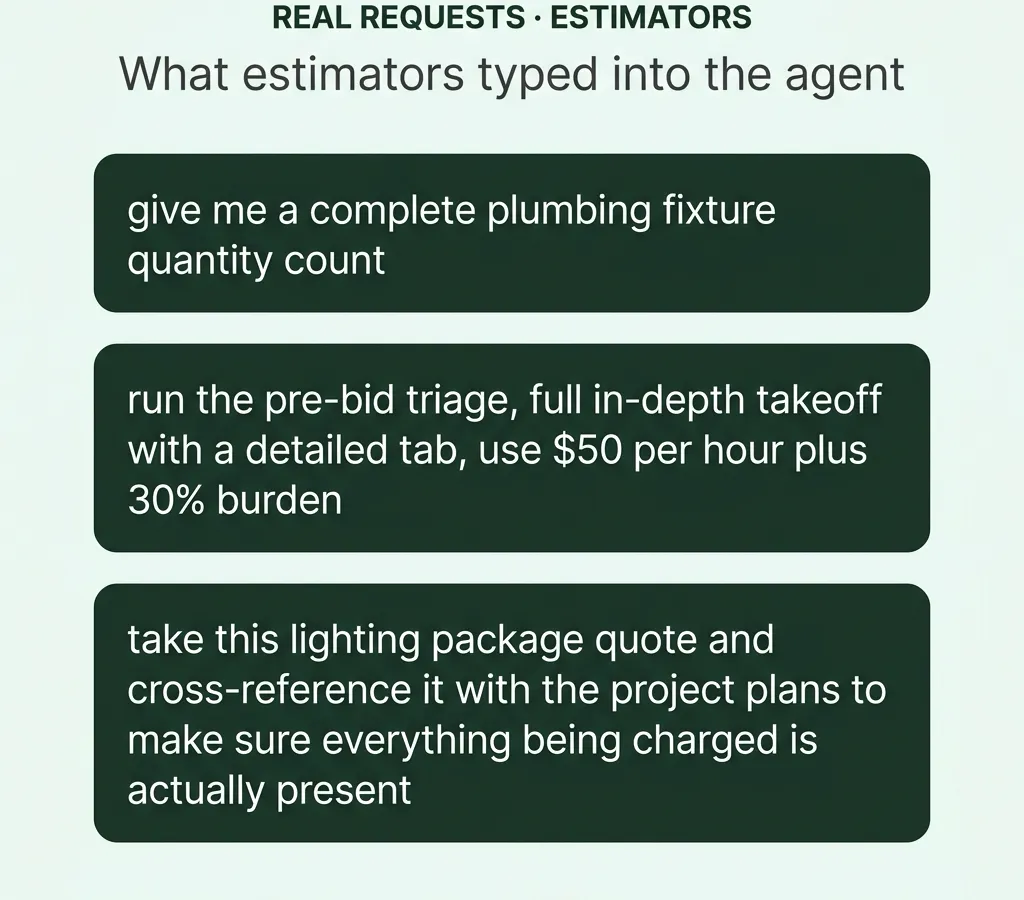
One estimator typed their own rate structure straight into a request: “$50 per hour plus 30% burden.” That’s $65/hour loaded, their number, not ours. The math below uses it, so you can swap in your own and see where you land.
Your takeoff: hours per sheet, not per project
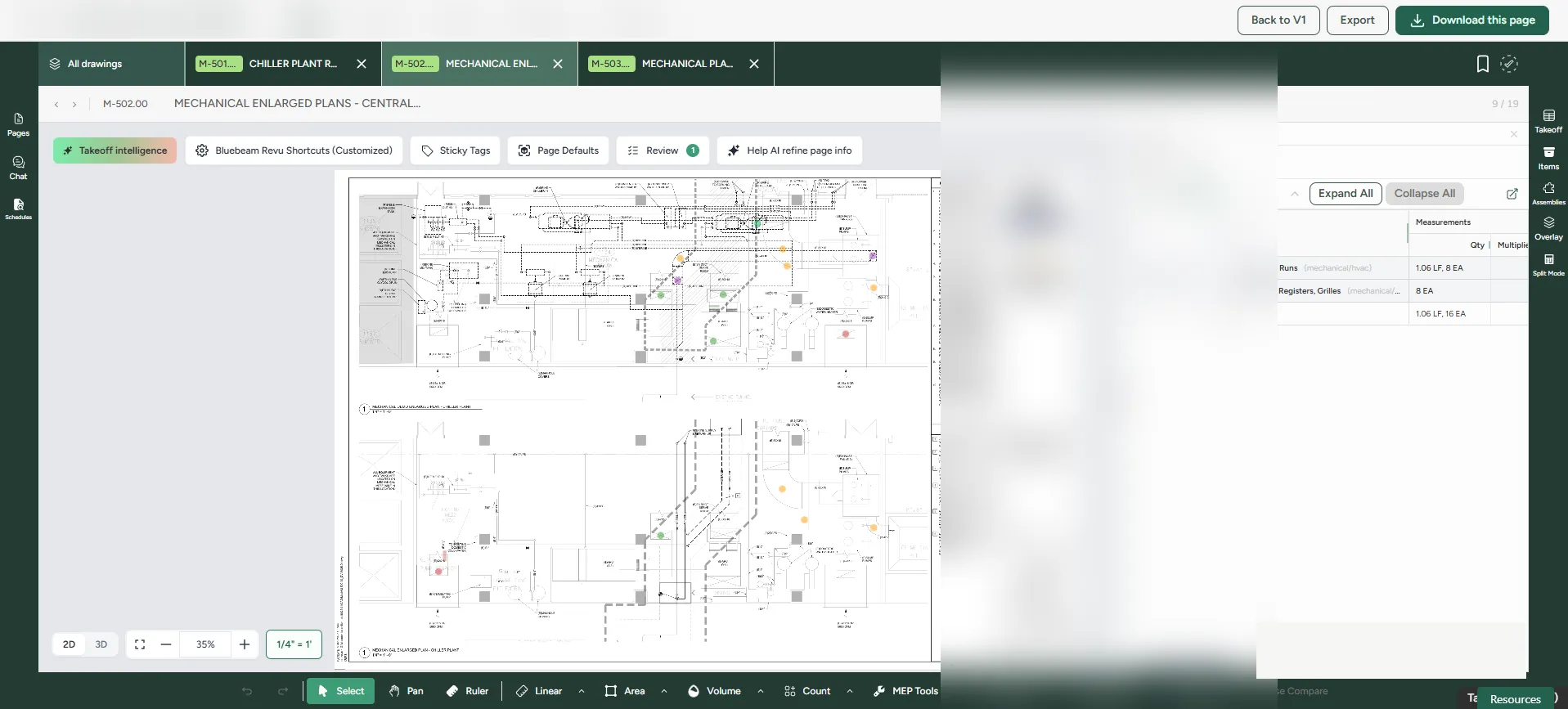
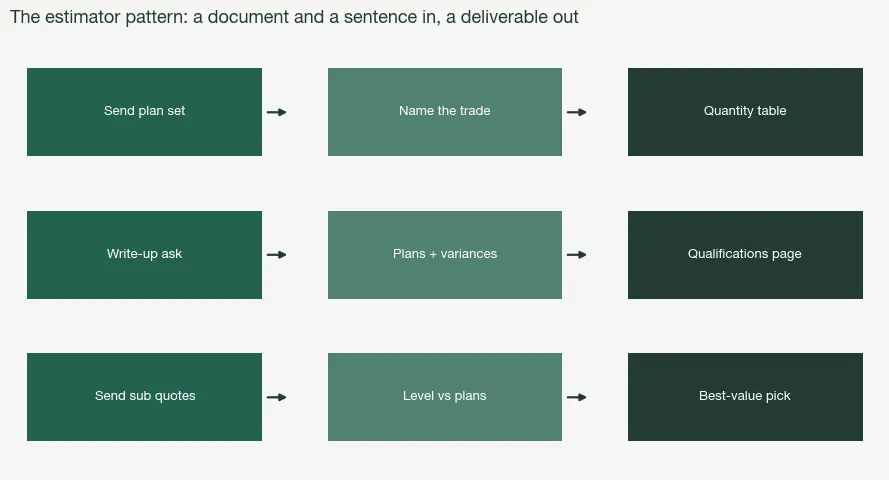
You send the set, you name the trade, you get the count. “Do a take off.” “Look at the irrigation drawings and give me a takeoff for 90 degree and 45 degree elbows.” “Run A device counts.” No assembly setup, no scale calibration, no template to configure first.
What that’s worth, from contractors doing it now:
- An electrical sub reports 2 to 4 hours saved per takeoff, roughly 1 hour per sheet. On a 16-sheet job that’s 16 to 24 hours. At $65/hour loaded, $1,000 to $1,600 back on a single job.
- A steel and structural contractor cut beam takeoffs by 25 to 30%: manual 3 days down to about 1 day, freeing ~2 days per bid.
- An electrical contractor doing lighting takeoffs went from ~2 hours per sheet to seconds.
- One electrical firm reports a 90% reduction in takeoff time.
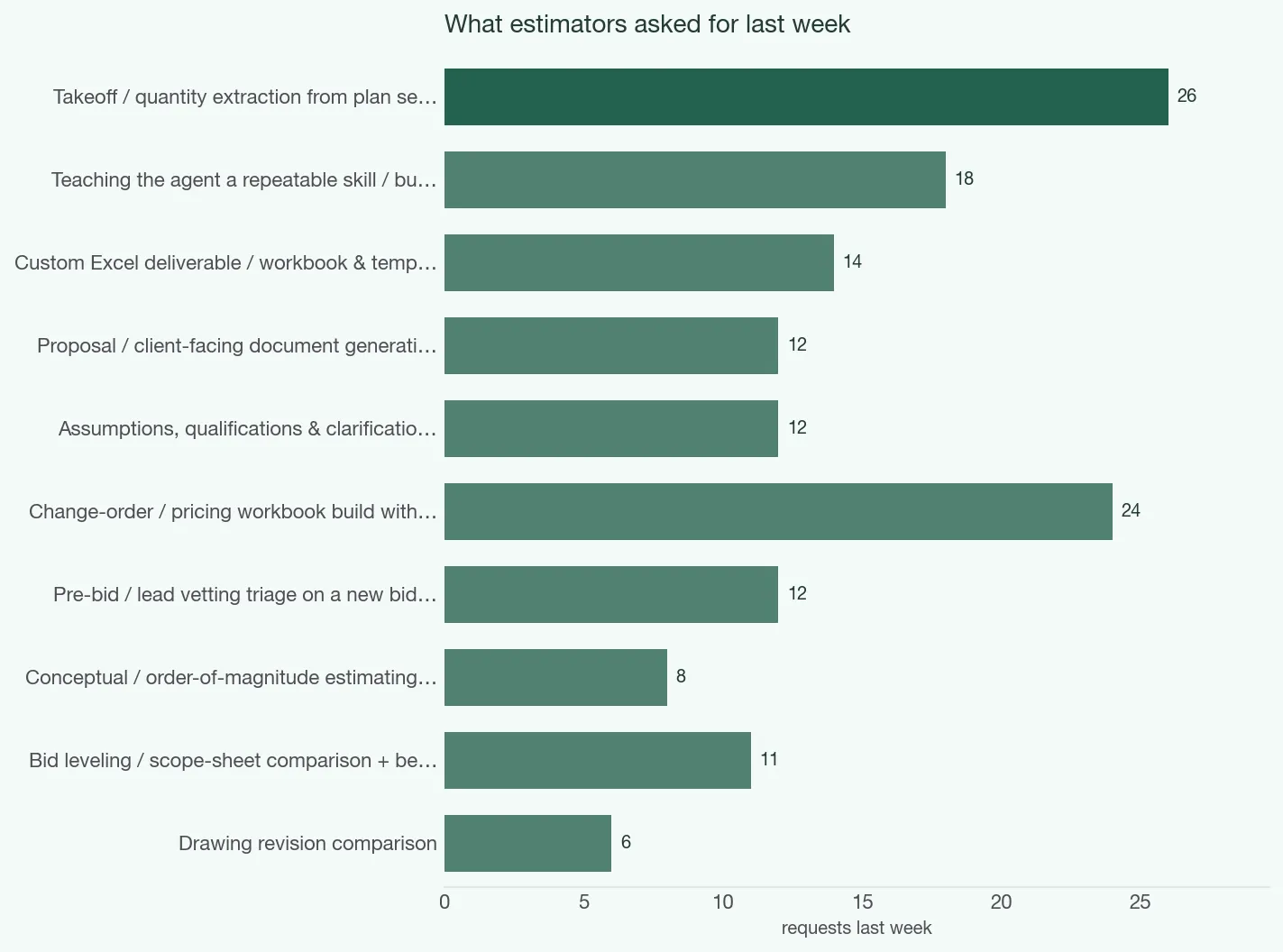
This was the single most-asked thing last week: 26 takeoff requests across 8 different contractors. The number that matters isn’t the percentage. It’s that 2 freed days per bid is either an earlier night or one more bid in the pipeline, and only one more bid compounds.
Your bid write-up: the qualifications page, drafted from the plans
“Write some assumptions and qualifications for the [project] reno.” “Cross reference the plans with these bids and create a list of clarifications and assumptions for any variances, separate it by division.” “What are some assumptions and qualifications you’ve picked up on?”
Twelve of these last week across three firms. The qualifications and clarifications page is the part of the bid you write at 9pm because it has to go with the number, and it’s the part that protects your margin when scope is fuzzy. Call it 2 hours you rarely have, so it gets thin, and a thin qualifications page is how you end up owning scope you never priced. Drafted from the actual plans with variances called out by division, that’s $130 of time back per bid and a cover letter that actually covers you.
Your vendor quotes: stop eating scope you didn’t price
Eleven bid-leveling requests last week. “Level these, give me the best value highlighted with the explanation.” “Use the attached scope sheet template to level the flooring bids.” “Here are two more bids to analyze with the other drywall bids.”
Line-by-line reconciliation of real quotes against the drawings is 2 to 3 hours you almost never have, so quotes get accepted on trust. The value isn’t the color-coded sheet, it’s the best-value pick with the reason written out so you can defend it. One caught line item, a fixture charged that isn’t on the plans, pays for a month of the software.
Your revision comparisons: where margin quietly leaves
“We received updated stamped 100% documents. I need to run a comparison from this 100% stamped set to the previous 100% documents and look for any items that would cause a big pricing fluctuation.” “Tell me the differences between the [project A] drawings and the IFC drawings.” “Do the same thing for the plumbing sets, make the notes into a word file.”
Manual set-to-set comparison runs 4 to 8 hours and it’s the most miserable work in the job. It’s also where margin hides: the question is never “what changed,” it’s “what changed that moves my number.” Note the last request, the estimator already had a comparison in the thread and pointed it at the plumbing sets, so the prior work carried forward. You extend instead of restarting, and that’s the difference between 20 minutes and half a day.
Your pricing workbook: the messy change order, priced four ways
“Now we’ve got to deduct the SES but add back the $15,500 cancellation fee, I need a workbook for that.” “I need to add 10% for PM time, don’t forget to add tax on top of that, I also need this to be built for the client’s eyes.” “Overhead and profit need to be at 15%, remove the contingencies.”
Twenty-four of these came from one contractor last week, which tells you something: once an estimator learns the agent will rebuild a priced workbook with new markups, tax, and O&P on request, they stop dreading owner changes. Rebuilding a client-facing pricing workbook by hand is 1 to 2 hours each, and it’s the work that makes owner meetings slip. Ask for the scenarios, get four priced options and a decision matrix in an afternoon.
Your format: the deliverable, not the answer
“Create an excel sheet for every piece of scope for all the trades you’ve told me so far.” “Transform this pdf into an excel.” “Generate an excel file with all the trades for bidding along with their CSI codes.”
An answer you have to retype into your workbook is half a deliverable. Transcription is 1 to 2 hours per handoff and it’s pure waste, the analysis was already done. Ask for it in your format, with your CSI codes, and that hour disappears.
What this adds up to
Take the conservative middle on a normal week: 1 hour per sheet on takeoffs, a 2-hour qualifications write-up, 2 hours of bid leveling, half a day on a revision comparison, an hour reformatting. At $65/hour loaded you’re looking at $1,300 to $2,000 a week per estimator in recovered time, before counting a single avoided change order.
One general contractor now produces scope checklists and bid-leveling summaries in minutes instead of the hour it used to take, saving ~1 hour per project. Another ran a full pre-bid workflow (triage, bid package, spec review) in about 7 minutes, work they estimated at 112 to 154 hours by hand.
You don’t need a new vocabulary to get this. You send the set, you name the trade, you state your rate, you attach your template. Same sentences you’d use with a junior estimator.
Send us a plan set and pick your worst trade. That’s the whole ask.