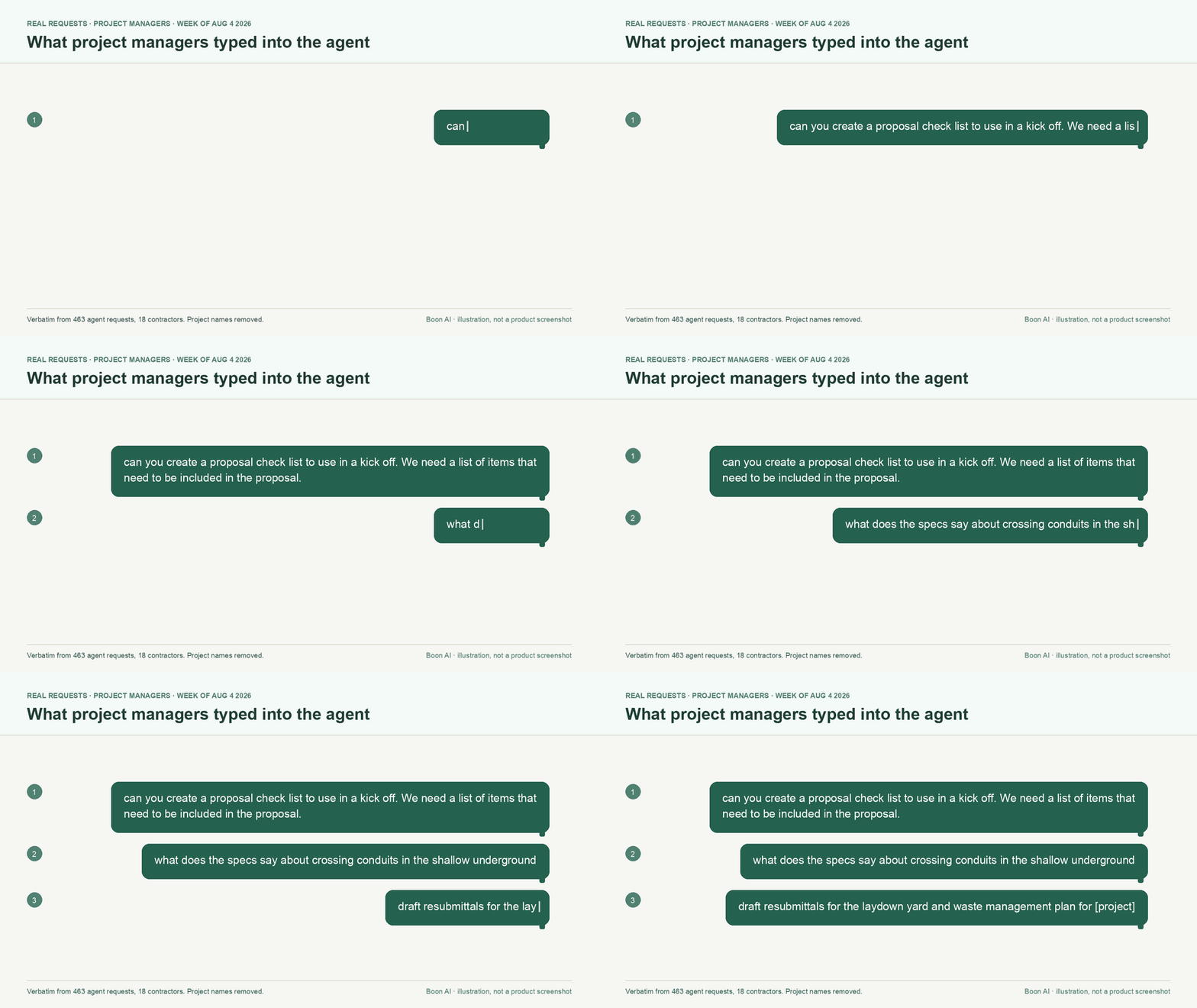
Four shops sent us twenty-four one-line asks in seven days that all rhyme: find this callout in the drawings, find this schedule in the specs, find this requirement buried three sections deep. Not “summarize the plans.” Not “explain the spec.” Point at the sheet, point at the schedule row, point at the paragraph. Project managers live in the fifteen-minute stretches between meetings and superintendents. They do not have the hour to open a 400-sheet set and go hunting. The single biggest ask of the week from this crowd was the boring one: just answer where it is.
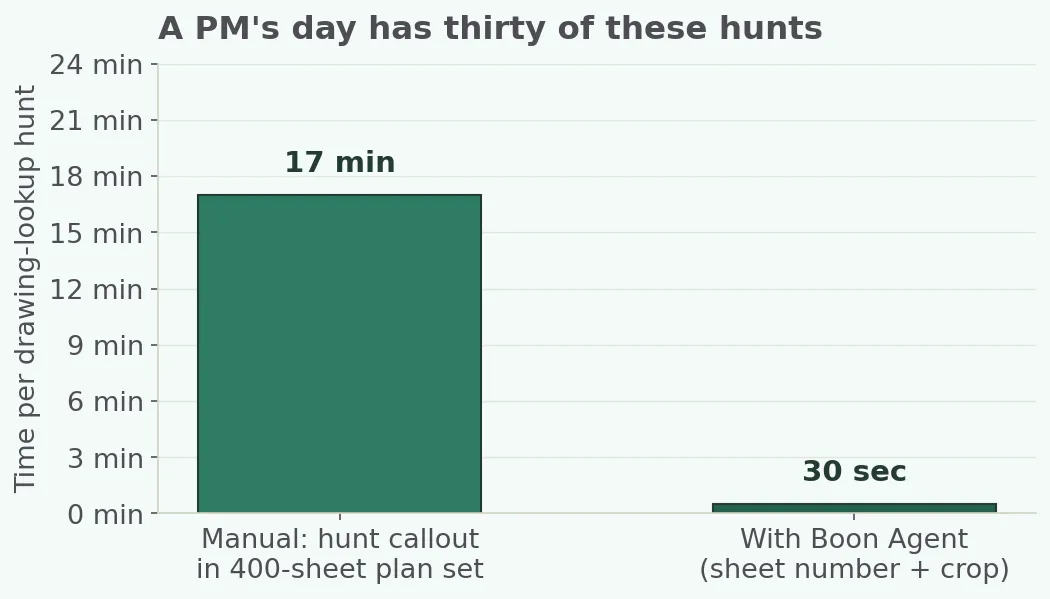
The math is small numbers times a lot of questions. A PM hunting through a 400-sheet plan set for one callout runs about 15 to 20 minutes per hunt, sometimes 40 when the callout got moved between revisions. At a fully loaded rate of $65/hr (a real customer’s math from a chat this month: $50/hr plus 30% burden), that is about $16 to $22 per hunt, and the day has thirty of them. Roughly $500 a day of a PM’s time disappears into “where is this on the plans.” And the ones you cannot find in the fifteen minutes between meetings turn into an RFI that a sub is now waiting on for three days.
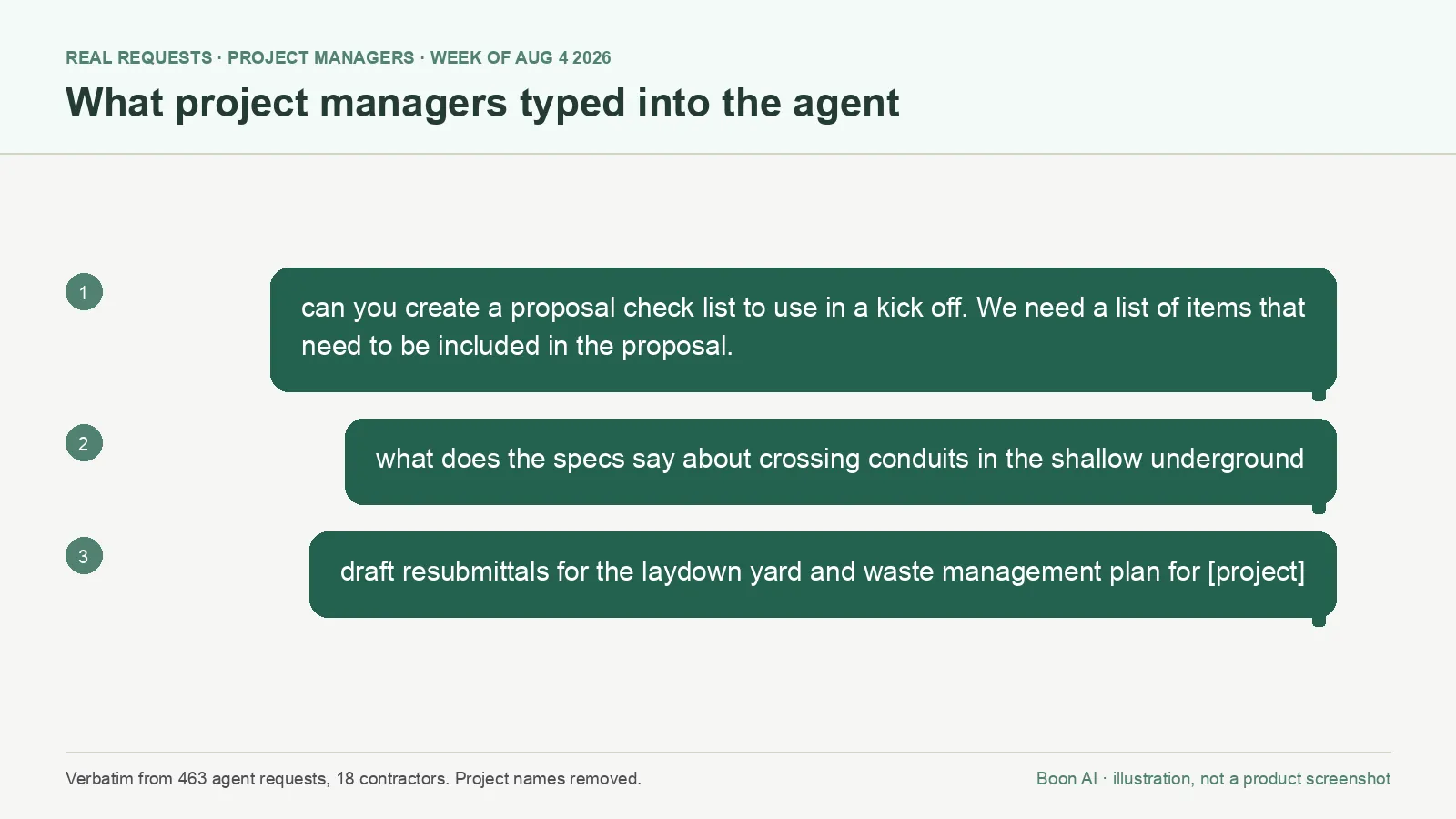
Here is what PMs actually handed the agent this week, in their own words.
Answer the drawing question. With the sheet number. And the crop.
The top ask this week, in their own words:
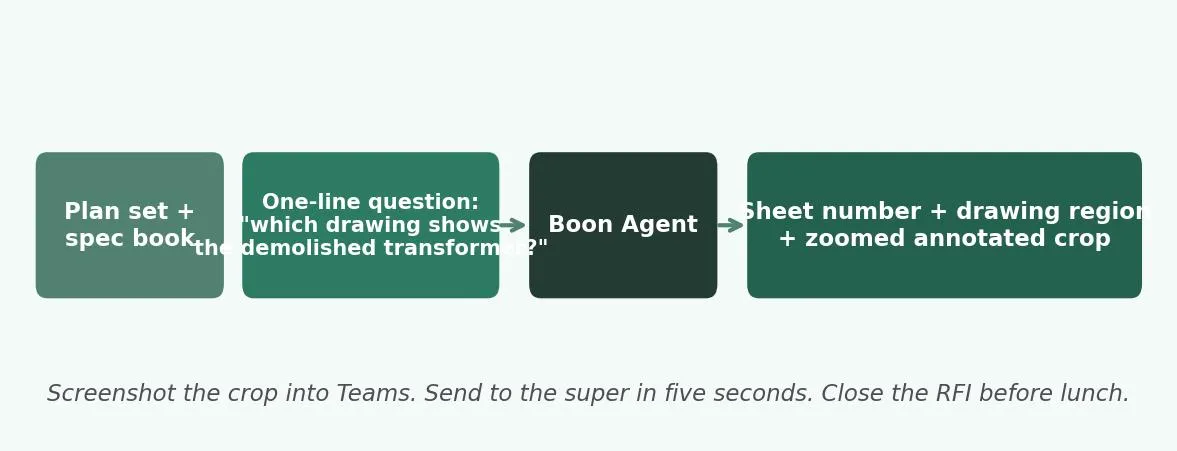
“which drawing shows a previously demolished transformer ?”
“the parking lot has some type S1 fixtures. i can’t find those in a fixture schedule. where is that?”
“please provide me with the size of the S-1 site lighting fixture”
You point the agent at a plan set, ask a one-line question, get back the sheet number, the drawing region, and a zoomed annotated crop of the exact spot. Twenty-four repeats in a week, from four shops. Fifteen minutes of hunting becomes a thirty-second lookup.
On a day with thirty of these, the PM recovers roughly seven hours, nearly a full day, which is either the day they close six long-open RFIs, or the day they walk the site. An electrical sub we work with told us the equivalent lookup pattern on their side runs about an hour saved per sheet, and on a sixteen-sheet job that stacks to 16 to 24 hours saved on the job. On a busy PM’s calendar, that is the difference between shipping a submittal Friday afternoon and shipping it Monday morning.
The important part is not the speed. It is that the crop is on the answer. The PM can screenshot it into a Teams reply to the super in five seconds. The super does not have to open the drawings themselves. That single hand-off is why the ask keeps repeating.
Read the spec book. Draft the RFI list. Before the pre-bid meeting.
Second-biggest ask was the pre-bid triage, allowances, alternates, GC special requirements, and an RFI list drafted before the estimator opens the drawings:
“Review the plans and specifications of this project. Provide duration, list of allowances, list of bid lots or alternates, special requirements in the general conditions, etc”
“MVISD - reference back to the scope sheet on Sharepoint that has Div 21. Draft questions I need to send to Fire King”
“Now can we hand these RFIs off to Ryan Companies to answer”
You point the agent at the spec book, get back a pre-bid triage, duration, allowances, bid lots, alternates, special requirements, plus a first-pass RFI list drafted from the questions the specs left open. Twelve asks in a week, from three shops. A pre-bid triage by hand runs about six hours of a senior estimator’s or PM’s time, or roughly $390 of loaded time per bid. Twelve of those in a week says three of the shops we work with are doing about six of these bids each, and half a workday per bid is disappearing into “what’s in this book.” A general contractor we work with told us bid-related scope work that used to take about an hour per project by hand now runs in minutes with the agent. Multiply that across the three or four active pre-bid meetings a PM is prepping in a given week, and you get the second afternoon back in the calendar.
Submittal versus spec. Approved. Not approved. With the citation.
Third pattern was submittal review, one submittal against one spec section:
“please review this product data against the spec requirements for permeable pavers and let me know if it is acceptable.”
“this is a pdu submittal for atl06 does it call out a torque value for the main and a breaker?”
“double check the submittal against the plans”
You drop in a submittal PDF and the spec section it is meant to comply with, get back an approved/not-approved read with the spec paragraph cited and the mismatched attributes flagged. Eight asks in a week, from three shops, a smaller bucket, but every one of those asks is a PM who was about to send the submittal back to the sub with an incorrect approval, or approve one that should have been kicked back. A manual submittal-versus-spec pass runs about 1.5 hours per submittal, or roughly $98 of loaded time. A single missed non-compliance on a permeable paver, or a missing torque call-out on a PDU, is the field callback that costs the job the whole month.
The agent does not approve. The PM approves. The agent gives the PM the citation that says: paragraph 3.2.B says the torque value must be listed; the submittal does not list it; kick it back. That is the shape of a compliance tool the PM will use twice a day.
What next Monday’s ask should be.
The drawing-Q&A ask is the one that keeps producing new questions every day, because a PM’s day IS thirty of these hunts. The next Monday’s ask is to point the agent at the current project’s plan set and spec book once, and start throwing one-line questions at it in the fifteen-minute stretches between meetings. The 15 minutes per hunt you recover the first day is what buys you the pre-bid triage the second day and the submittal review the third. The seven hours a day back is not a headcount answer. It is the day you actually walk the site, and the four RFIs you close before lunch, and the submittal you send Friday afternoon that would have been Monday.
Metrics cited (per-sheet time savings, per-project hour) are from closed-won construction customers. Full attribution kept in the internal appendix.