One ask, two shops, ten repeats: run the firm’s own go/no-go scoring pass on a fresh invitation to bid, and pull the closest historical job as the benchmark before an estimator opens the drawings. Precon leaders do not want a summary of the ITB. They want a decision-support artifact, a scored pursuit memo that tells them whether the shop should be spending an estimator’s week on this, and if so, which job in the archive it looks like.
The bucket is thin this week, ten asks, two firms, and that is a real signal, not a problem. The go/no-go conversation only happens at the top of a shop. It is the VP of preconstruction and the chief estimator making a hundred-thousand-dollar decision about whether to spend an estimator week on a bid that pays out one time in five. Ten repeats from two shops means both are running this loop deliberately, on every ITB, on the same scoring rubric. The math is straightforward. A full estimator week on a bid costs roughly 40 hours x $65/hr, or about $2,600 of estimating time, all-in, before subs get quoted. One correctly killed pursuit a month pays for the whole line item. The precon leader’s job is to move that decision from month-end gut instinct to Monday-morning arithmetic.
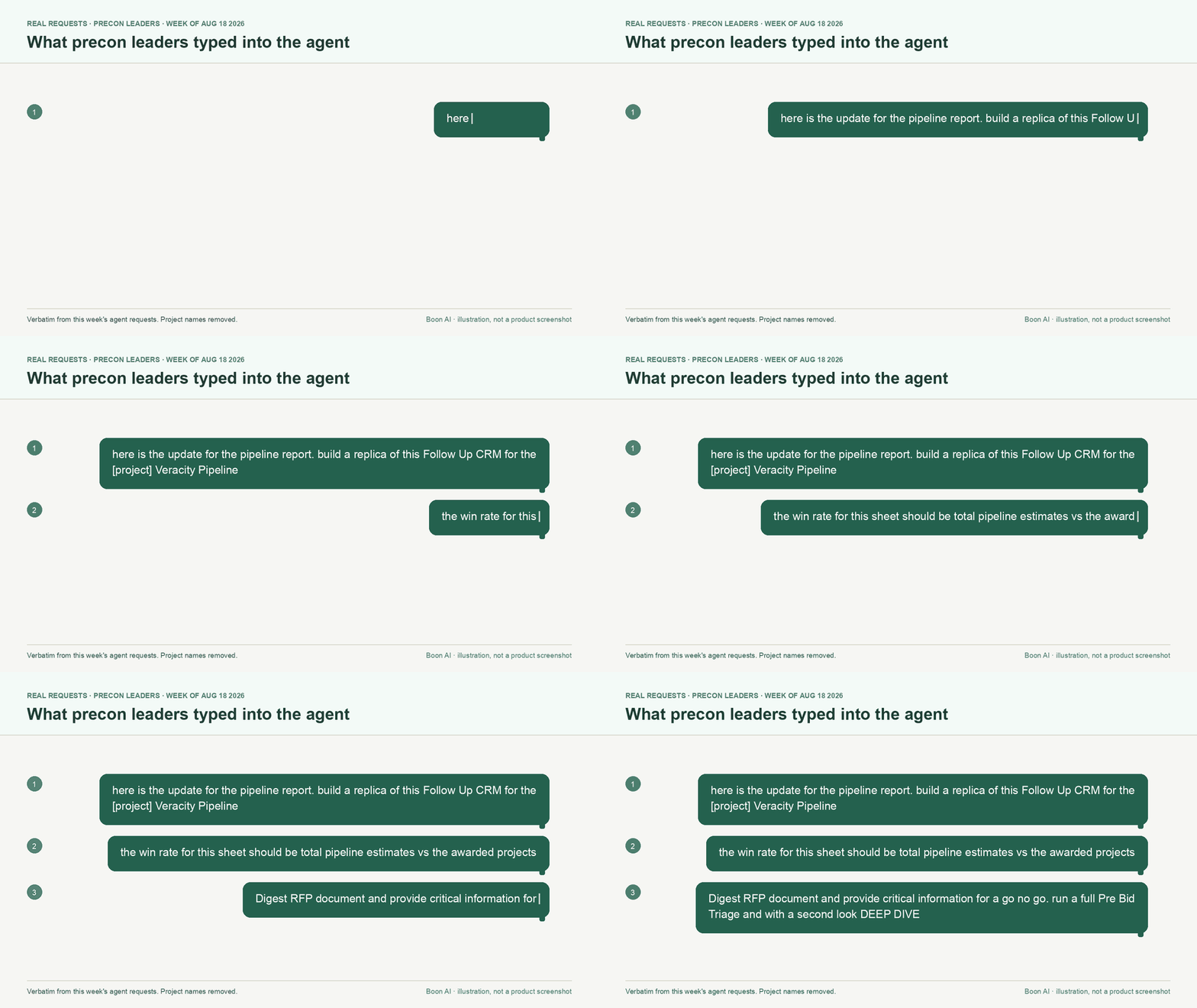
Here is what the precon leaders actually handed the agent this week, in their own words.
Run the scoring pass. On our rubric. Before we spend an estimator week.
The pattern this week is unmistakable, the precon leaders are asking for a named scoring pass, by name:
“Please run the Guido go or no go on the attached CMAR at Risk”
“can you run the Guido go or no go on the attached”
“run the go/no go on this project”
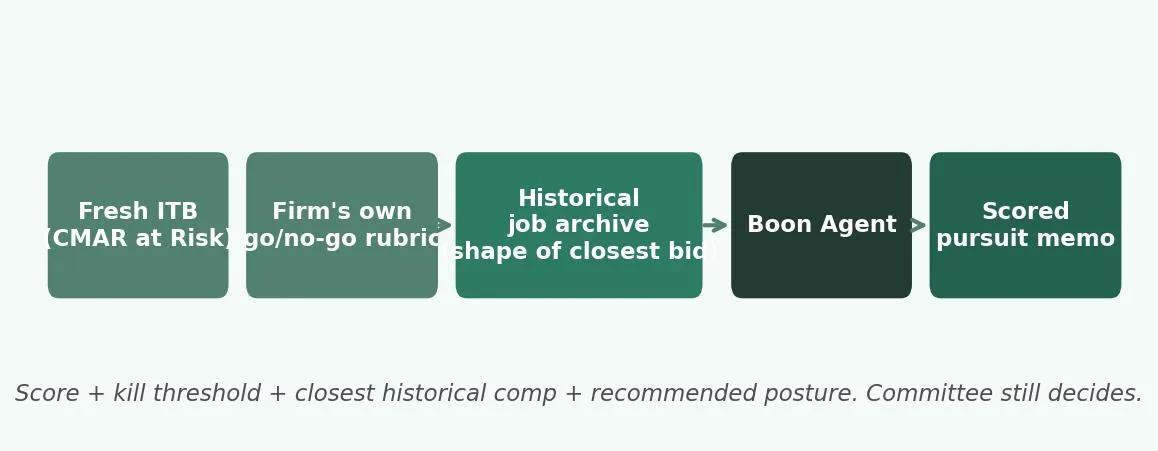
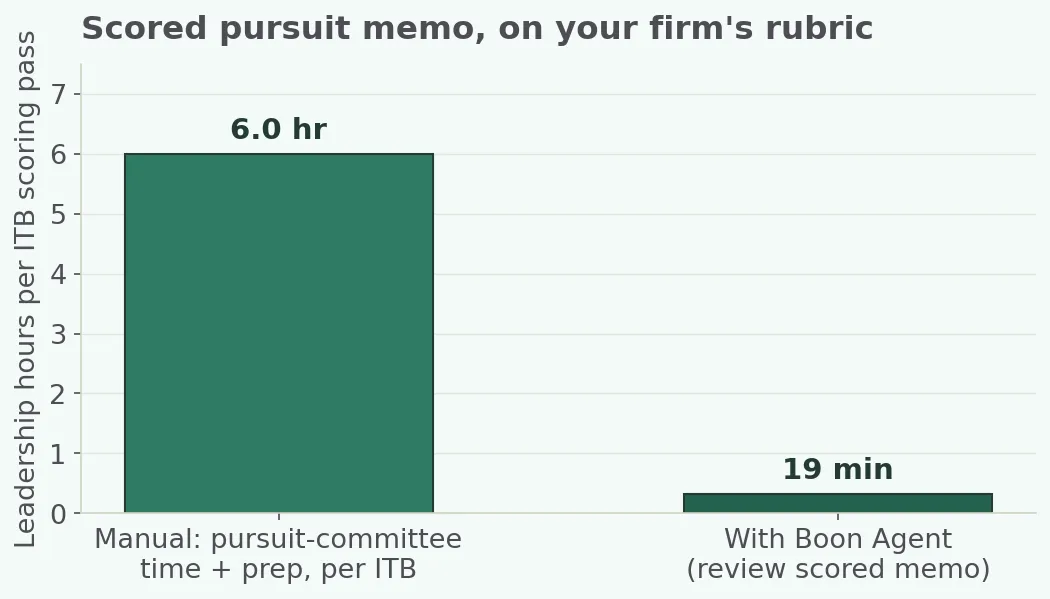
The firm, a Southwest GC we work with, encoded its own go/no-go rubric into the agent months ago, and now every ITB gets a first pass against that rubric before the estimator opens the plans. This week that pass ran ten times, on ten fresh CMAR-at-Risk invitations. Two hours of scoring-committee time, the VP, the chief estimator, and the ops lead sitting in a room reading the ITB, becomes a twenty-minute review of a scored memo. At loaded rates that is roughly $390 of leadership time recovered per ITB, ten times this week, or about $3,900 of “should we even bid this” time back in one week for the two firms running it. And the memo is uniform every time, which is the part your CFO cares about, the same scoring rubric on every pursuit, the same threshold for a killed bid, the same evidence for the win-rate memo at year end.
The point of encoding your rubric is that the shop stops arguing about which factors matter, and starts arguing about which score they earned. That is the conversation you want at the pursuit committee. The agent does not decide. It scores, and the humans in the room own the call.
The closest historical job. From your archive. As the benchmark.
The second part of the ask, implicit in every repeat, explicit in a couple, is the historical comparison:
“here are the drawing to run the pre bid triage this is a budget to award i need two solid passes uses are standard process and rates”
“for this budget, use my usual estimating rates and burden. also look at similar jobs we did on this campus last year for the shape of the bid.”
You point at the ITB, and the agent pulls the closest historical job from the firm’s own archive, not a benchmarking database, not a national average, and hands you a memo that says: “this looks like the 2024 CMAR-at-Risk you bid at 2.4% margin, here is what won it, here is what closed to plan, here is what surprised the crew.” A civil GC we work with ran a similar full pre-con workflow (triage, bid package, spec review) in about seven minutes with the agent versus 112 to 154 hours manually on a manual pass. That is not the go/no-go alone, that is the whole triage, but the pursuit memo is the front door. If seven minutes gets you a scored decision plus a historical benchmark, the entry cost of running the pass on every ITB drops to zero. You run it on all of them.
What the scored memo actually says.
The scored pursuit memo is the deliverable that closes the loop, and it looks the same on every ITB the firm scores. The scoring rubric is yours, factors, weights, thresholds, all encoded once. The output is a two-page memo, in the firm’s format, with:
- The scored total against your kill threshold.
- The three or four rubric line items that pulled the score up or down, with the evidence pulled straight from the ITB.
- The closest historical job in the archive, with its margin, its bid duration, and the two things that surprised the team last time.
- A recommended posture, pursue with senior estimator, pursue with junior for practice, decline politely, decline hard, that the pursuit committee can accept, override, or ignore.
The agent is not deciding. The precon leader is. The agent is just giving them a memo shaped like the memo they were going to write themselves at 10pm on Sunday, four hours faster, with the historical comp already attached. Four hours of committee prep time per ITB, at roughly $260 of leadership time, recovered for the six calls the leader would rather be on.
What next Monday’s ask should be.
The go/no-go rubric is the artifact worth encoding once. Ten repeats from two shops in one week says: this is a workflow the precon leader keeps running once the setup is done, and there is no ceiling on how many ITBs get scored. The next Monday’s ask, if you have not encoded the rubric yet, is to send a blank scoring template, the factors, the weights, the kill threshold, and the last three ITBs you scored by hand, so the agent has calibration. After that, every fresh ITB gets the memo. The one estimator week of misdirected pursuit that this catches, once a month, is where the year finds its margin.
Named firms encoded as “a Southwest GC” and “a civil GC” for external copy. Full attribution kept in the internal appendix.