SEO targets: ai agents for construction | agentic ai in construction, ai construction tools
Most industries adopt new technology because someone at the top decided to modernize. AI agents for construction are arriving for a blunter reason: the math stopped working. There aren’t enough estimators, the ones who are left spend most of their week on work that doesn’t need their judgment, and the errors that slip through cost real money on real jobs. When the pressure gets high enough, the tools that actually do the work get pulled in whether or not anyone planned for it. Construction is at that point now.
I want to lay out why, because the timing isn’t an accident and it isn’t hype. The structural conditions that make a vertical ready for agents are all present here at once, and they’ve been building for a while.
The conditions behind AI agents for construction
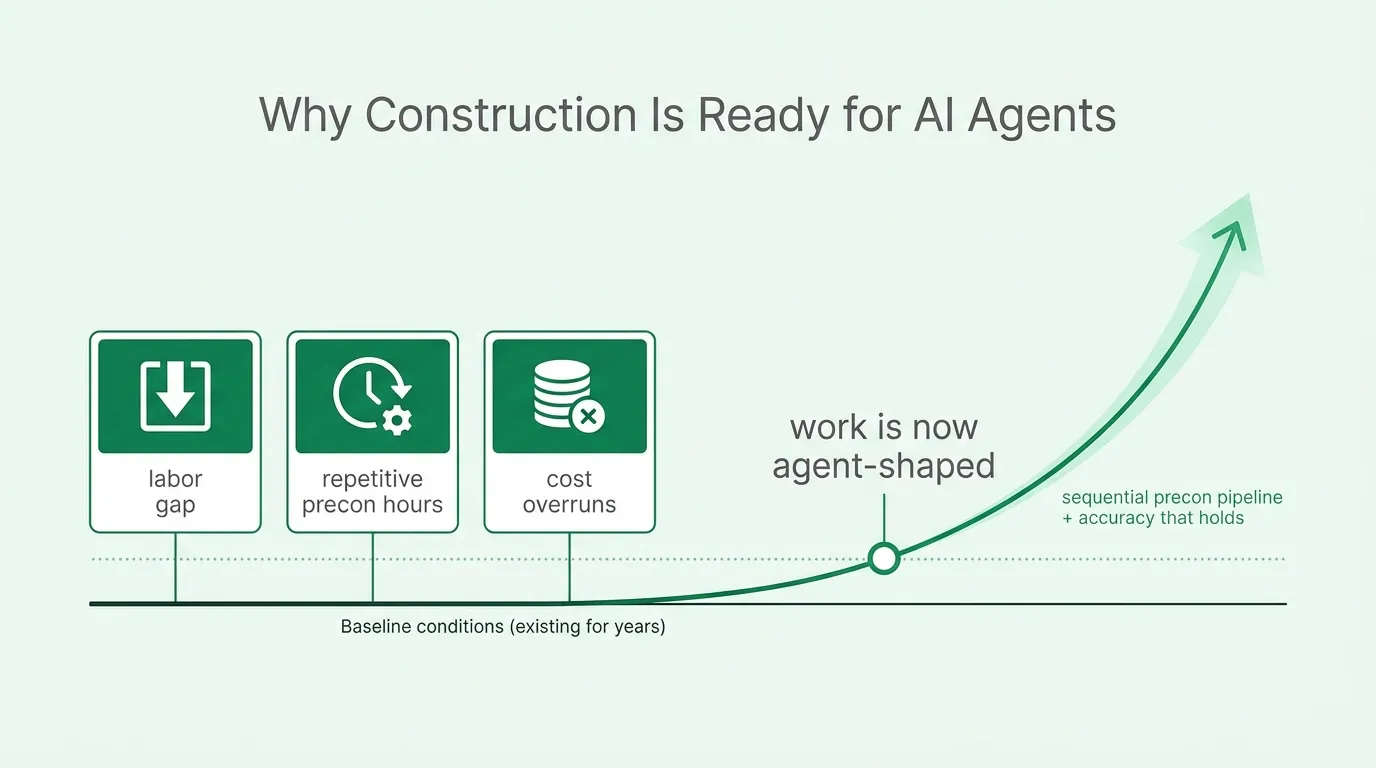
Three facts sit underneath the whole argument.
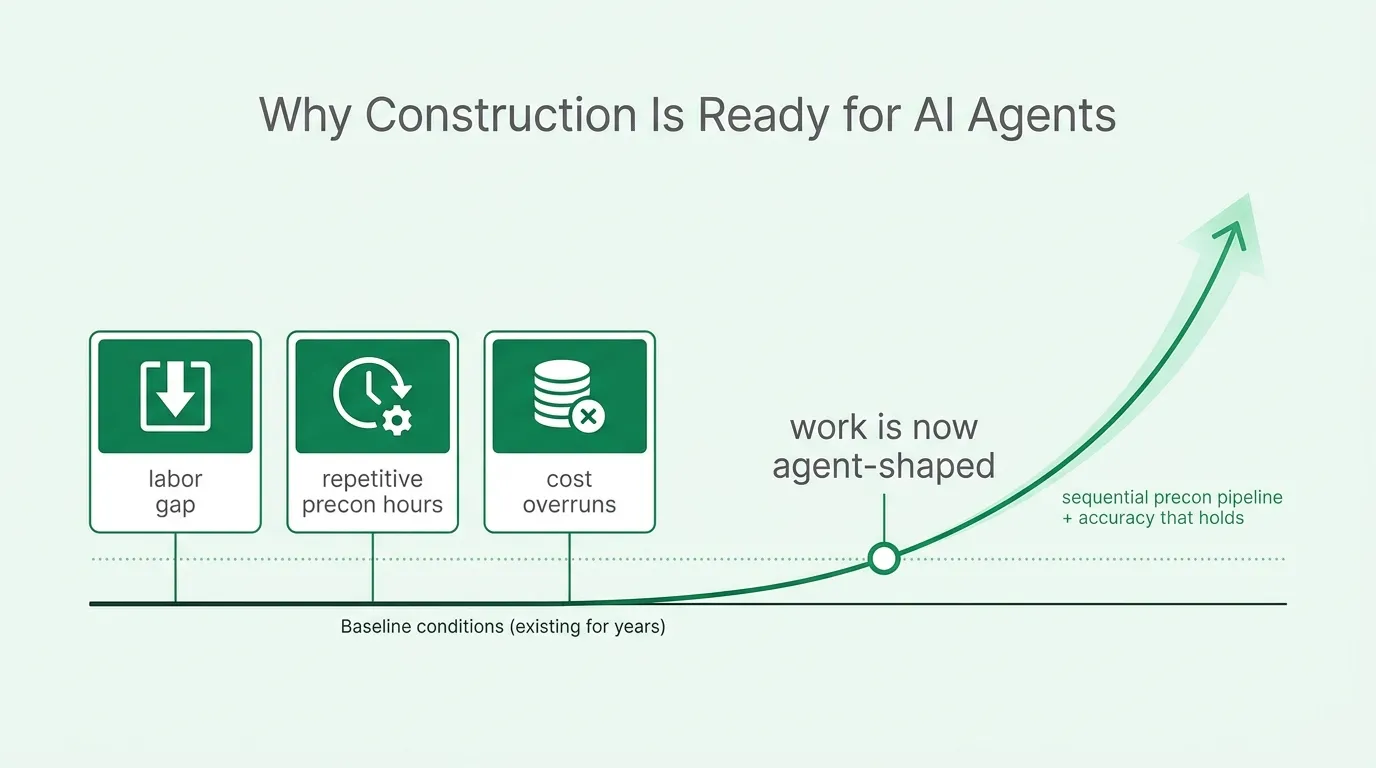
The first is people. The estimating bench is thin and getting thinner. The senior estimators who can read a full bid set and price it correctly are retiring faster than firms can train replacements, and the pipeline behind them is short. Every firm I talk to is trying to bid more work with the same number of, or fewer, experienced people. That’s not a preference for automation. It’s a headcount problem with no easy hire on the other side.
The second is where those people’s time goes. Estimators spend 20 or more hours a week on repetitive preconstruction work: paging through drawings, doing takeoffs, cross-checking specs against plans, chasing sub quotes, formatting the same comparison the same way for the tenth time. That’s more than half a work week spent on tasks that need care but rarely need genuine judgment. The judgment happens in the last hour, on the pricing call and the risk read. The other 20 are setup.
The third is what happens when the setup goes wrong. Estimating errors drive roughly 32% cost overruns on affected projects, and 52% of delays trace back to inaccurate takeoffs. A number that’s off by a little at bid time compounds through buyout, scheduling, and the build, and by the time it surfaces on the jobsite it has propagated through half a dozen downstream decisions. In construction the cost of “approximately right” is not a rounding error. It’s margin, and sometimes it’s the whole job.
Why now, and not five years ago
Every one of those pressures existed five years ago. What’s changed is that the work is finally shaped like something an agent can run.
Preconstruction is a sequence. A bid set comes in, it gets read, the scope gaps get found, the RFIs get written, the sub quotes get leveled. Each step has a clear input, a defined output, and a handoff to the next. That structure is exactly what an agent needs to be useful. It isn’t an open-ended conversation, it’s a pipeline with stages, and stages are automatable when the technology is good enough to hold accuracy across them.
The deadline pressure is what turns readiness into adoption. Bids don’t slip. When three are due Friday and the estimator who’d normally carry two of them is out, the firm doesn’t get to extend the deadline. It either finds a way to do the work or it doesn’t bid, and not bidding is how firms lose the pipeline that keeps them alive. An agent that can take the first pass on a bid set is not a nice-to-have in that week. It’s the difference between submitting three and submitting one.
What separates a real agent from a wrapper
Readiness invites a lot of entrants, and most of them will be wrappers. A text box on top of a general-purpose model, pointed at construction, calling itself an agent. It’s worth being clear about the difference before the category fills up with them, because the wrong pick costs a firm a season.
A wrapper answers questions about the work. A real agent does the work. Hand a wrapper a bid set and it’ll summarize it, maybe answer what you ask, and leave the sequence to you. Hand a real agent the same bid set and it reads the full thing, finds the scope gaps where the drawings and specs disagree, drafts the RFIs those gaps require, and levels the sub quotes when they come back. One produces commentary. The other produces the artifacts the estimator would otherwise have built by hand.
The second difference is accuracy that holds across the sequence. A wrapper riding a general-purpose model guesses plausibly on the easy pages and guesses plausibly on the hard ones too, and the estimator can’t tell which is which until the bid is awarded. That’s worse than no tool, because it adds a checking burden without earning trust. A real agent is built for the domain’s accuracy bar, where the right answer is a specific number and the wrong answer looks identical on the page. In a vertical where a one percent miss on a mid-sized job is a five-figure swing, that bar is the whole game.
The third difference is where it lives. An agent that makes the estimator open a new dashboard is an agent they abandon by week three, because their work already happens somewhere else. A real agent runs inside the tools the team is already in, Slack and Teams, so the workflow comes to them. Boon Agent is built on all three of these: it runs the full precon sequence, it’s purpose-built for construction accuracy rather than wrapped around a general model, and it lives where the team already works, self-serve, no new tab to abandon.
The flag worth planting
Construction has a reputation for being slow to adopt software, and it’s earned. Twenty years of dashboards that estimators stopped opening will do that. But the reputation misreads the cause. The industry didn’t reject software because it was conservative. It rejected software that added work instead of doing it, that sat in a separate tab, that couldn’t be trusted on the hard sheet. Those tools deserved to be ignored.
An agent that clears those bars is a different proposition, and the conditions that would make a firm say yes to it are all here now: not enough estimators, too many hours going to repetitive work, and errors that cost more than the software ever will. The firms that figure out which agents are real, and put them on the repetitive 20 hours so their people can spend the judgment hour where it matters, are going to bid more work with the bench they have. The ones waiting for the category to settle will watch competitors submit three bids in the week they managed one.
The opening is now. The only question a firm has to get right is which agents actually do the work and which just talk about it.
If you want to find out where your own precon week is going, try Boon Agent on a real set of drawings and see what it runs on its own.
Deepti Yenireddy is the founder and CEO of Boon AI.