Some numbers describe a faster workflow. This one describes a different company.
Veracity Electric, a regional electrical contractor, is building toward running roughly three times the estimates it does today — on the exact team it already has. On the firm’s own math, that is the working capacity of about four additional full-time estimators, none of whom Veracity has to find, hire, or train in a market where senior electrical estimators are almost impossible to replace.
“If I can take a job that would take us five to seven working days and get that down into two to two and a half days to that proposal out the door, I’m doing three times as many estimates as we were before — with adding no more employees. That’s where the key comes in.”
Scott Kelly, Chief Estimator, Veracity Electric
This is the story of how a firm that used to turn work away built a plan to nearly triple its output without growing its headcount.
The bottleneck was never skill. It was hours.
Veracity runs a sharp, conventional preconstruction stack and a senior team that knows how to count. Scott Kelly has done this for thirty years. He knows exactly what an hour of a senior estimator’s time is worth, and exactly what it costs to spend it on the wrong thing.
The wrong thing, for a precon team, is speculative work. A budget request isn’t a bid — it’s a fast, rough number a GC wants so they can shape a project that may or may not happen. Chasing it burns four, five, six senior hours on a number with a coin-flip chance of ever becoming revenue. So firms ration. They take the budget requests they can afford and turn the rest away.
“Without something like this, we’d probably turn most of them away. It pulls resources away from estimating on real jobs.”
Scott Kelly, Chief Estimator, Veracity Electric
Every “no” is a small relationship cost with a GC. Enough of them, and you’re not on the shortlist when the real project lands. The constraint was never whether Veracity could produce good work — it was whether they could afford the hours.
Where the hours come back
Boon didn’t make Veracity’s estimators faster typists. It removed the two places their days disappear.
Budgets: most of a day, down to under an hour
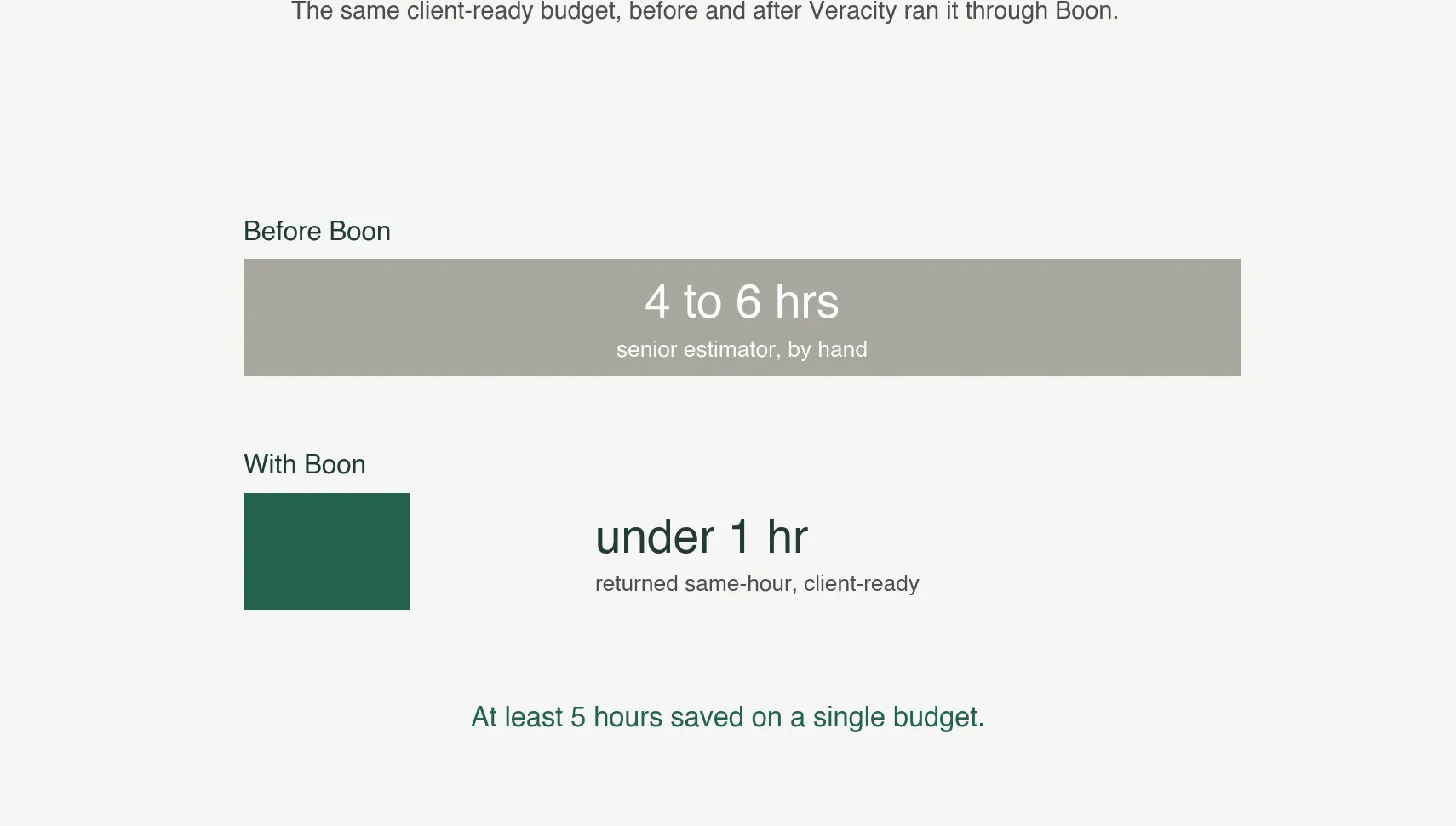
The first proof came on a real budget request. A GC sent a set over; Scott ran it through Boon’s agent — Veracity calls theirs “Merlin” — and returned a complete, client-ready budget the same hour.
“They sent that to us and we sent it back to them in less than an hour. And most of that time was me just deciding to run it through. We would have spent four, five, six hours looking over that. So it saved at least five hours.”
Scott Kelly, Chief Estimator, Veracity Electric
Not a rough cut — it went straight to the client with scope and exclusions. When his estimating manager flagged a missing fire alarm, Scott pointed him to the exclusions section: already carved out, explicitly.
“That was a good budget that we actually sent right out to the client. Every I was dotted and every T was crossed. I don’t know that you could put something any better together to send them.”
Scott Kelly, Chief Estimator, Veracity Electric
Veracity sees three to four of these requests a week — the kind they used to decline. Answering them turns a cost center into a positioning move.
“We’re able to put budgets out like that, we now become a partner versus just another subcontractor. That’s a preferred partner for some of these GCs.”
Scott Kelly, Chief Estimator, Veracity Electric
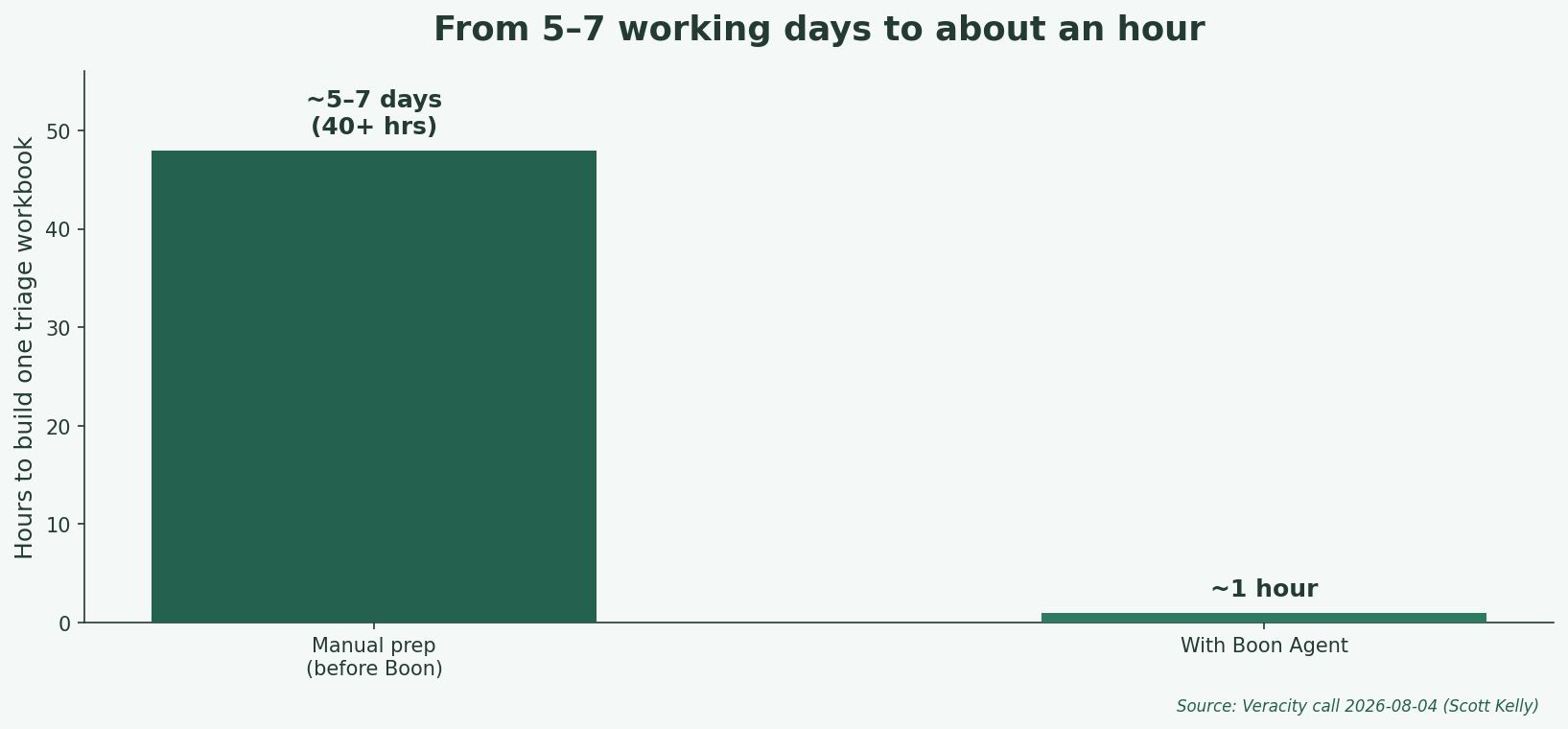
Triage: a full day of senior work, run by anyone
The bigger pool sits upstream of the takeoff entirely — the triage that eats an estimator’s day before a single quantity gets counted: pulling scope out of the specs, reading the means and methods, surfacing the RFIs a drawing set will generate.
“Being able to have it dive into the specifications and drawings and extract the scope of work, the means and methods — the time that saves is literally almost a day. Even if it takes Merlin an hour to do that, that’s priceless. Come back an hour later and it’s done.”
Scott Kelly, Chief Estimator, Veracity Electric
The leverage isn’t only the hour-for-a-day swap. It’s who can do the work. Triage no longer needs the senior estimator at all.
“Rachael, or any project assistant, can upload it into Merlin and say, do the full triage: get me the scope of work, give me the RFIs, categorize them most-important to least, put it on a spreadsheet. You do five or six of those in a day, you just set an estimator up to add a whole other job to his schedule over a couple of weeks.”
Scott Kelly, Chief Estimator, Veracity Electric
A project assistant feeds the agent; the senior estimator inherits a finished triage and a cleared calendar. That is the engine behind the capacity math.
The math the firm actually cares about
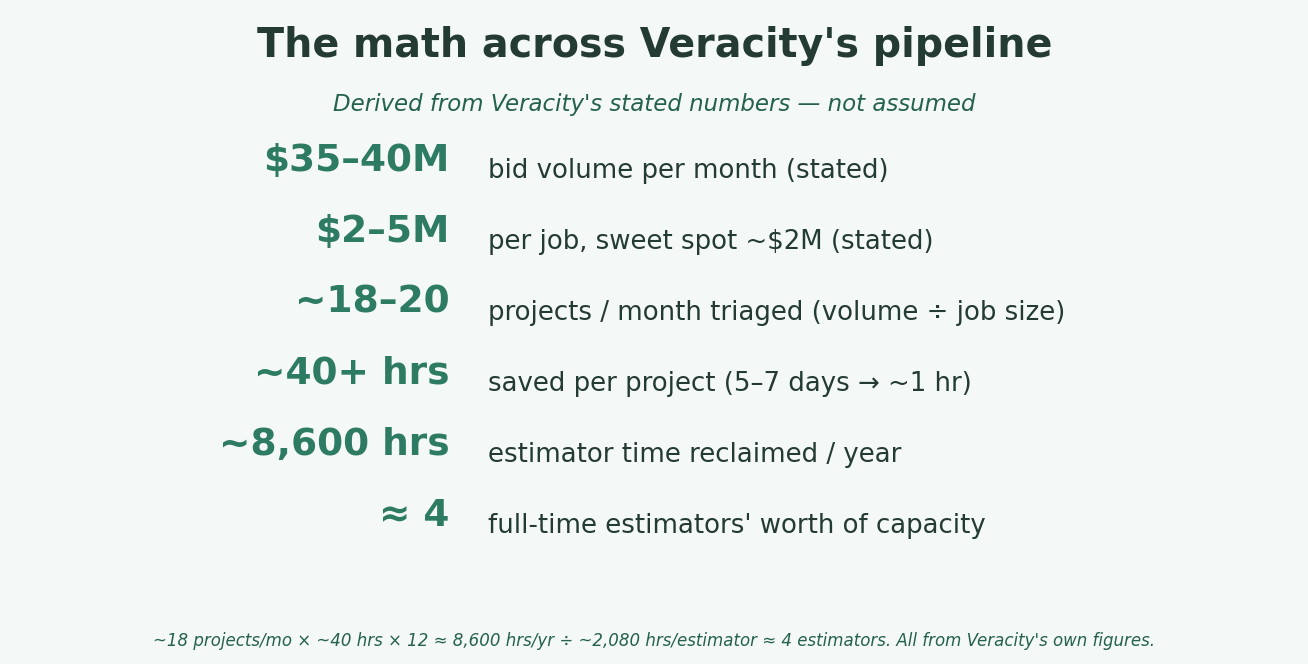
Time saved per bid is a proof point. Capacity is the prize. Three estimators running at roughly three times their old pace do the work of about nine — which is why Scott frames the unlock as roughly four full-time estimators of net-new capacity, on the team he already employs.
His ambition sizes it. Veracity put out about $50M in estimates this June. The steady-state target is $35–40M a month; the goal Scott is building toward is $100M a month at the same 15–20% win rate.
“If we can go from the 35 to 40 a month that we want to be at, to 100 million a month, and keep that win ratio at 15 to 20 percent, you can see the volume that it brings in and the growth that it allows.”
Scott Kelly, Chief Estimator, Veracity Electric
That is not a productivity tweak. It is a plan to nearly triple the top of the funnel without touching headcount — and it rests entirely on the estimating team being able to answer three times the work it can today.
What’s running at Veracity today
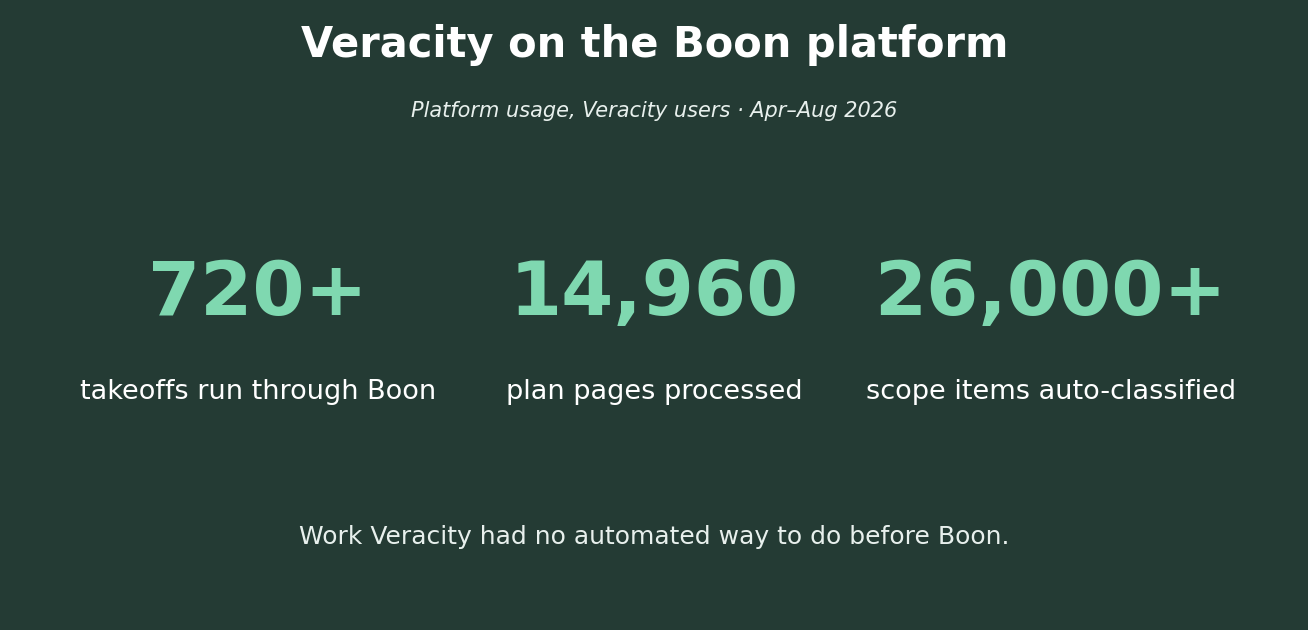
Everything below is in active use on real budgets and real projects — not features shown in a demo. Across roughly three and a half months on the platform, the team has run more than 700 takeoffs across dozens of projects, processed nearly 15,000 plan pages, and auto-classified more than 26,000 scope items on those drawings.
- Budget estimates returned to GCs same-hour, client-ready with scope and exclusions
- Full project triage: scope-of-work and means-and-methods extraction from specs and drawings
- Automated RFI generation, prioritized and exported to a spreadsheet
- A growing library of priced assemblies the team is building toward one-command takeoffs
The agent runs as a chat companion with the full takeoff platform behind it. Veracity started on Slack and is moving to Google Chat to live inside their existing environment — same intelligence, just meeting the team where they already work. The impact is spreading past estimating, too: one email the agent sent on Scott’s behalf pulled the VP of Finance and the project managers into asking how they get on it.
What’s next
Takeoff is the next unlock. Scott has deliberately built confidence on the low-risk work first — budgets, lead-vetting triage, turnover-meeting prep — before turning the agent loose on high-stakes takeoff in Q4, with one estimator dedicated to mastering it and then teaching the rest.
Scott’s read on where this goes is the one that matters, because he’s weighing it against thirty years of doing it the old way:
“It’s very, very powerful. The results it produces are going to be just as good, and better in some areas. I’m out there trying to sell you guys to other contractors.”
Scott Kelly, Chief Estimator, Veracity Electric
A firm that used to turn budget work away now answers it in an hour, uses it to win the relationship, and is building toward tripling its bid volume on the team it already has. That’s not a faster version of the old workflow. It’s a different position in the market — same team, same drawings the rest of the trade is still passing on.
Acknowledgements
With thanks to Scott Kelly, Chief Estimator at Veracity Electric, for his time and candor, and to the Boon team — Arjun Saharan, Sean Kim, Jon Maltais, and Joseph Hadidjojo — supporting the Veracity rollout.